Why you need a website in 2026: the 8 reasons that don't lie
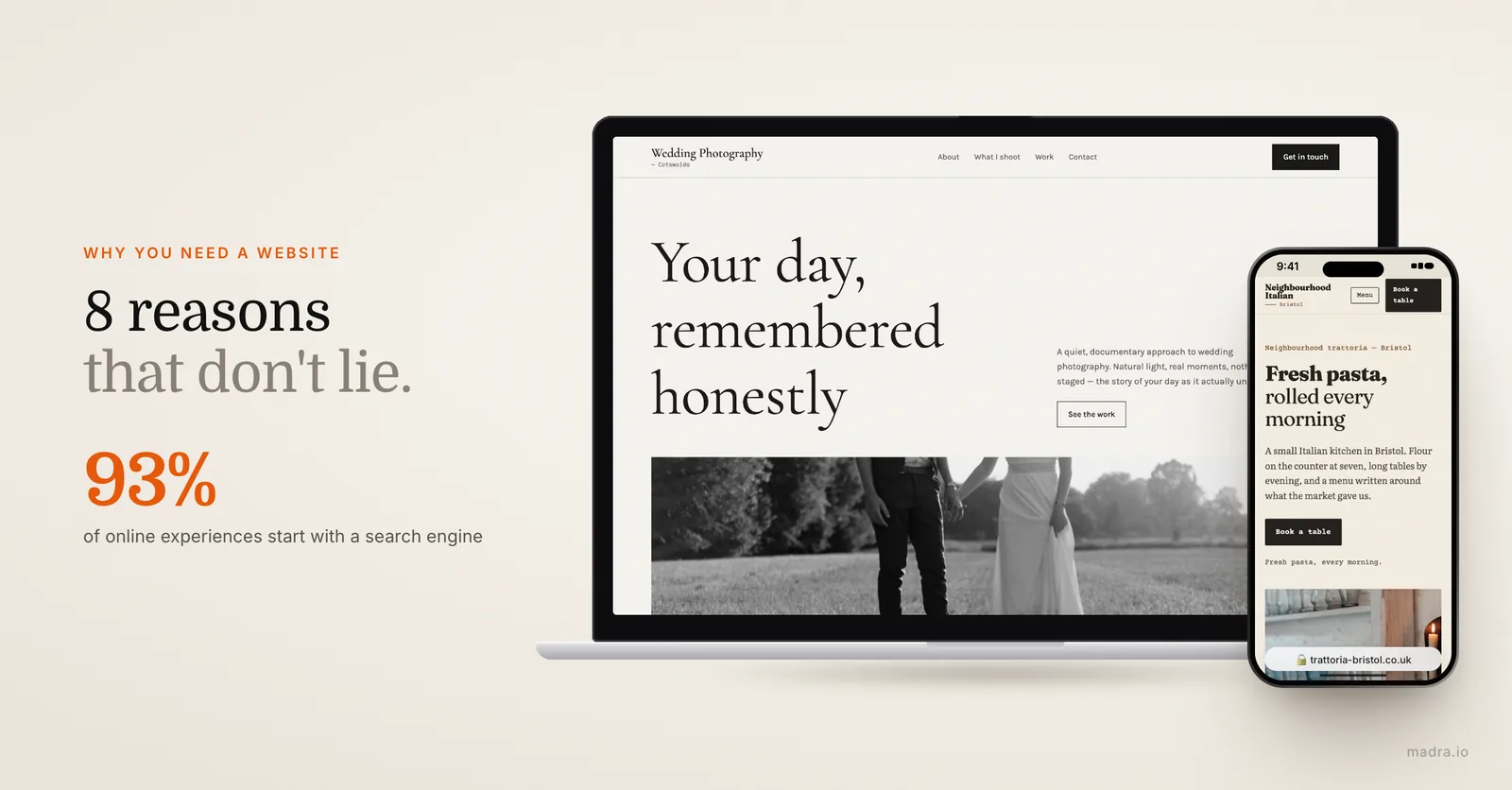
In 2026, 93% of online experiences start with a search engine. Not Instagram. Not Facebook. Google.
Yet a third of small businesses still don't have a website. Some think their Facebook page is enough. Others find it too expensive. And others simply don't see the point.
If you're still wondering why you need a website for your business, this article will settle the question. Not with vague arguments like "it's important to be online." With concrete facts, real numbers, and a reality you can verify yourself by typing your competitor's name into Google.
Here are the 8 reasons why a professional website is no longer optional in 2026 — it's a bare minimum.
1. Get found by your clients (not the other way around)
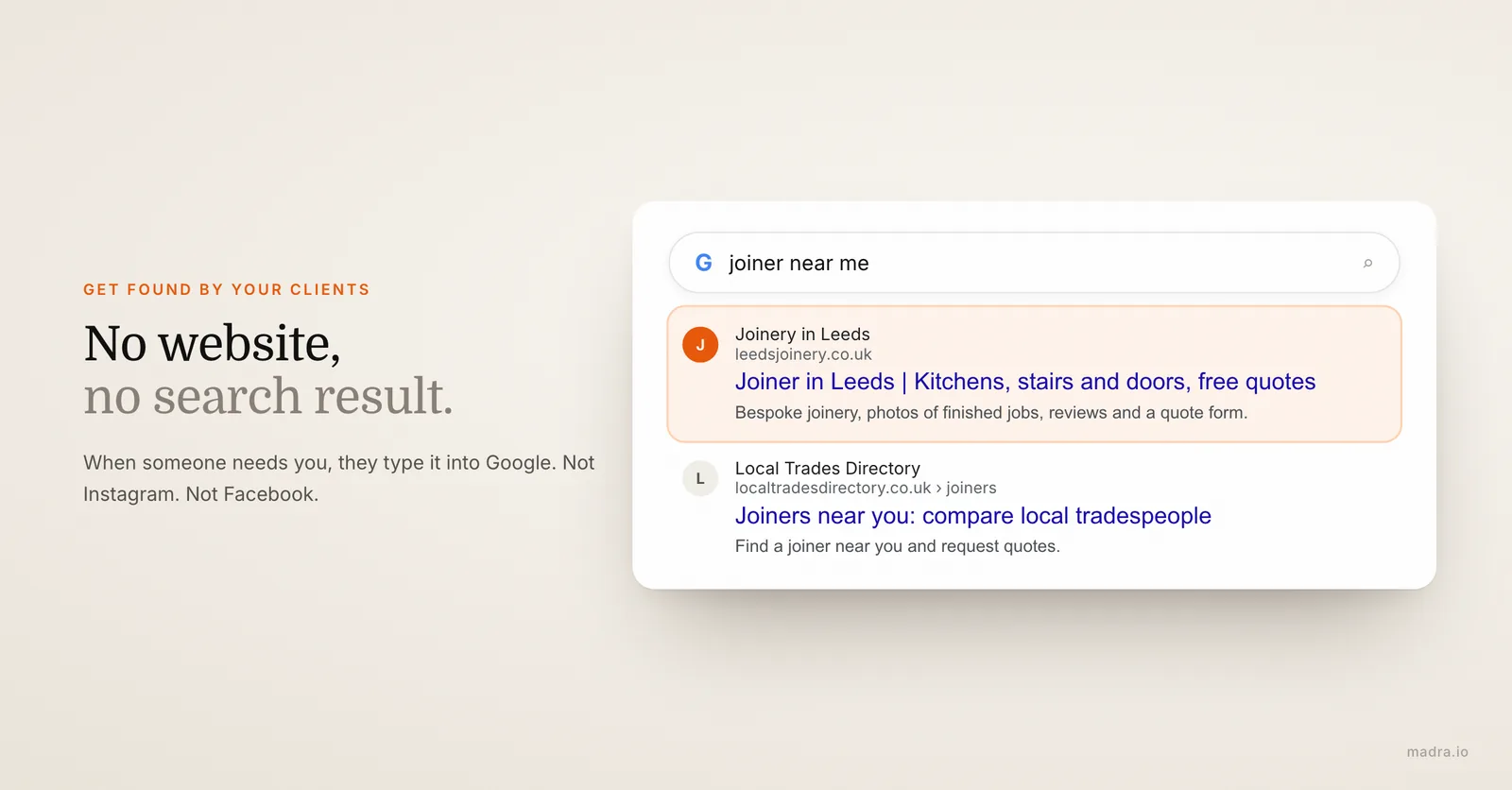
When someone needs a plumber, a fitness coach, a graphic designer, or a consultant, what do they do? They pull out their phone and type their search into Google. "Plumber near me", "personal trainer London", "consultant near me".
If you don't have a website, you don't exist in those results. Your competitor who has a site, even a basic one, shows up. You don't. The prospect clicks on their listing, not yours. Deal lost before it even started.
Local searches ("near me", "nearby") have exploded in recent years. In 2026, more than 76% of people who perform a local search visit a business within 24 hours. And to appear in those results, you need a website linked to your Google Business Profile.
A website is the foundation of search engine optimization (SEO). It's what allows Google to understand what you do, where you do it, and why it should show you to people searching for exactly your services. And with modern tools, you can create a website with AI and be live in 24 hours.
Without a website, you rely exclusively on word of mouth. It's a powerful channel, but it's a channel you don't control. A website is an acquisition channel you master from A to Z.
2. Gain instant credibility
Put yourself in your client's shoes. They're choosing between two service providers. One has a professional website with clearly presented services, customer reviews, and an "about" page with their photo. The other only has a Facebook page with posts from six months ago.
Who do they trust? The answer is obvious.
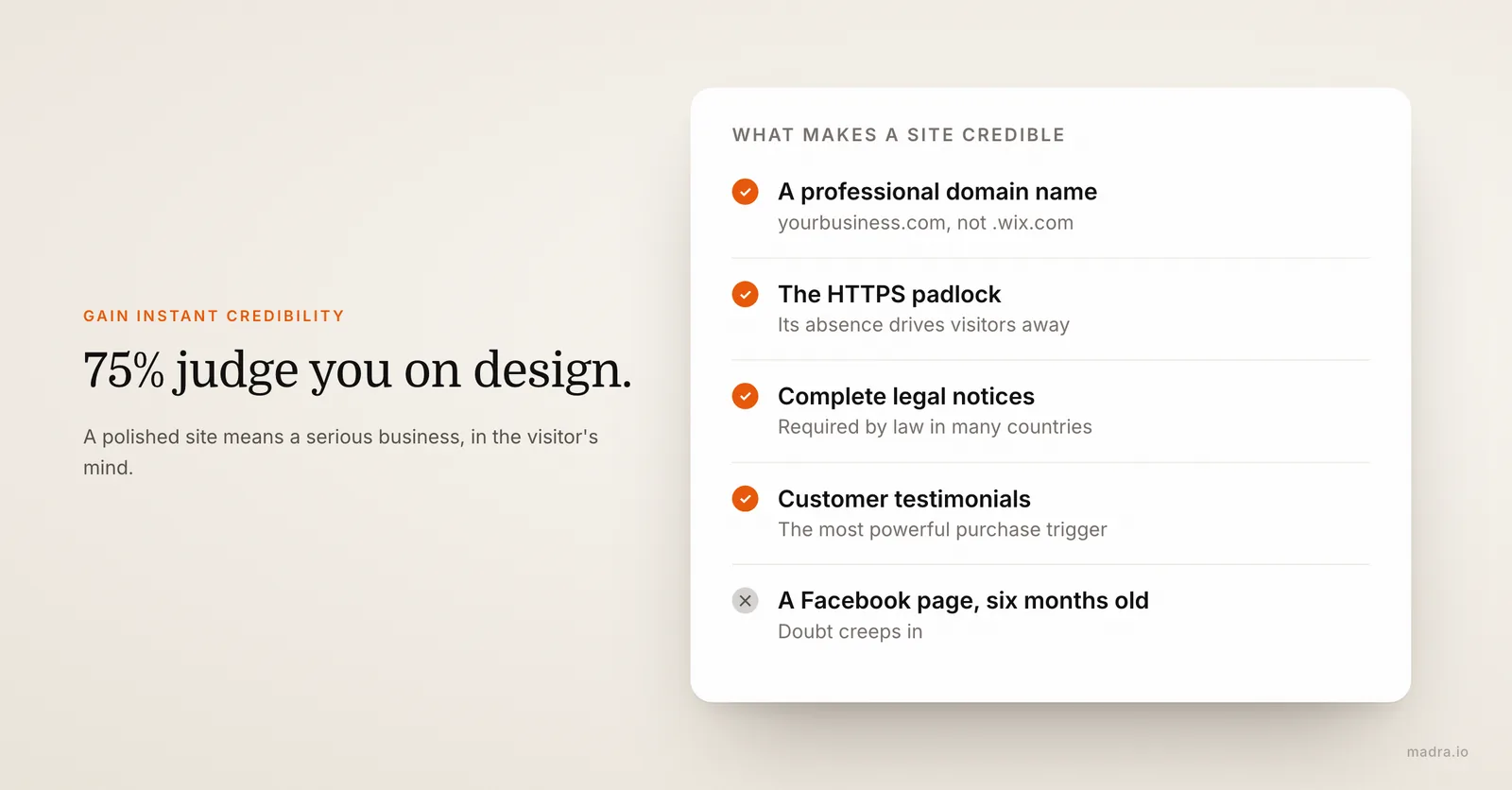
Studies show that 75% of consumers judge a business's credibility based on its website design. A polished site = a serious business, in the visitor's mind. A nonexistent or amateur site = doubt creeping in.
Online credibility isn't just about aesthetics. It's also about:
- A professional domain name — yourbusiness.com inspires more trust than yourbusiness.wix.com
- The HTTPS padlock — essential; its absence drives visitors away
- Complete legal notices — required by law in many countries and reassuring for visitors
- Customer testimonials — social proof remains the most powerful purchase trigger
Your website is your first digital impression. And just like in real life, you only get one chance to make a first impression.
3. Work for you 24/7
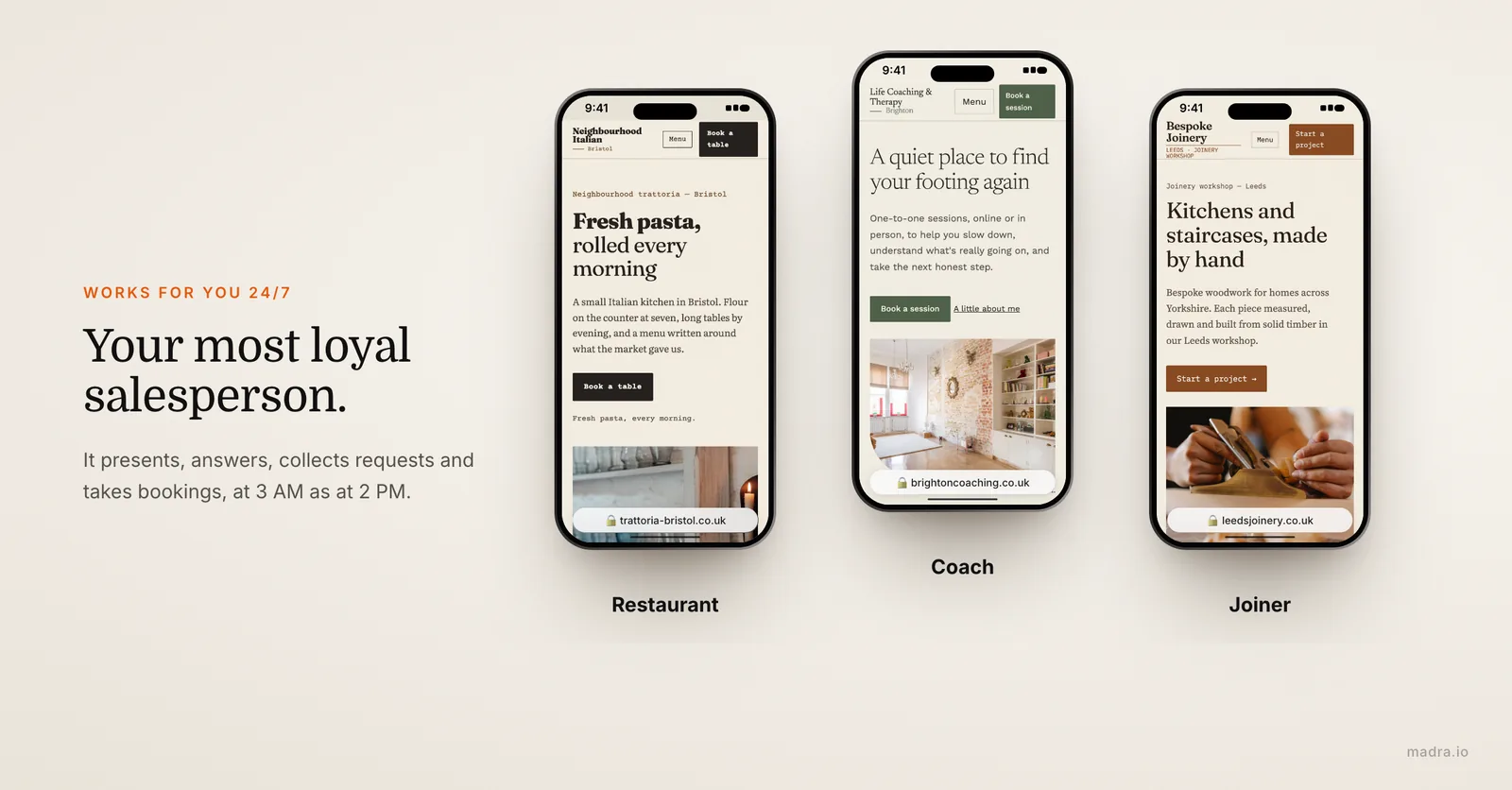
Your website is your most loyal salesperson. It never sleeps, never takes a holiday, never asks for a raise, and it greets your prospects at 3 AM just the same as at 2 PM on a Tuesday.
While you sleep, your website:
- Presents your services to someone typing your specialty into Google
- Answers frequently asked questions through your FAQ page
- Collects contact requests via your contact form
- Allows appointment booking if you've integrated a scheduling system
- Reassures the undecided with your client reviews and portfolio
A prospect who lands on your site at 10 PM and finds exactly the information they need is a prospect who'll send you a message the next morning. A prospect who finds your phone number but no website? They move on to the next one.
Every page on your site is a potential entry point. Your homepage, of course, but also your services page, blog posts, and FAQ. Each one can be found by Google and bring in qualified traffic. It's a cumulative effect: the more relevant content your site has, the more visits it generates.
Want a website that works while you sleep?
Quick form, site delivered in 24h, everything included from $29.90/month.
4. Stop depending on social media
Social media platforms are fantastic communication tools. But they're not your tools. They belong to Meta, TikTok, and X. And these platforms change the rules whenever they want.
Here's what can happen (and regularly does) when you build your presence exclusively on social media:
- The algorithm changes — overnight, your posts only reach 3% of your followers instead of 15%
- Your account gets suspended — a false report, a technical glitch, and you lose access to your audience for days (or permanently)
- The platform declines — remember MySpace? Google+? What's popular today can be a ghost town tomorrow
- You don't own your contact list — your followers belong to Instagram, not to you. You can't contact them directly
A website is your territory. You decide the content, the layout, and what the visitor sees first. Nobody can change your rules. Nobody can cut off access to your own storefront.
The smart strategy: use social media to drive traffic to your website, not as the final destination. Your website is the hub. Social platforms are just one of many acquisition channels.
5. Convert visitors into clients
Getting traffic is great. Turning that traffic into leads and clients is better. And that's exactly what a well-designed website does, unlike a social media profile.
A professional website includes clear conversion mechanisms:
- A contact form accessible from every page — the visitor can reach you in 30 seconds
- Visible calls to action (CTAs) — "Request a quote", "Book an appointment", "Contact me"
- A clickable phone number — one tap on mobile and the call launches
- A booking system — ideal for coaches and therapists, and consultants
- Detailed service pages — each service has its own page, with benefits, pricing, and a CTA
On Instagram, your prospect sees a post, watches a story, and... that's it. The conversion path is unclear. On your website, you control every step of the funnel: from discovery to contact.
A website that converts isn't a "pretty" website. It's a website that's clear, fast, and action-oriented. The visitor should understand in 5 seconds what you do and how to contact you. Everything else is secondary.
6. Control your brand image
On social media, your content is buried in a feed. It's displayed between a cat video and a sneaker ad. You control neither the context, nor the formatting, nor the display order.
On your website, you decide everything:
- Your colors, typography, and atmosphere — every element reflects your identity
- The order of information — you guide the visitor through the sequence YOU choose
- The editorial tone — casual or formal, friendly or corporate, it's your call
- The visuals — your photos, your work, not the random suggestions of an algorithm
Your website is the digital extension of your brand. It's the place where your prospect will form an opinion before they even speak to you. If your site accurately reflects who you are and what you do, the first call is already half won.
The benefits of a professional website in terms of branding are incomparable with any social media profile. You have an entire space dedicated to your brand, without distraction, without third-party ads, without format limitations.

7. Cost less than you think
The myth of the 5,000-euro website dies hard. In 2026, it's completely disconnected from reality for a business showcase site. For a detailed breakdown, see our guide on how much a website really costs.
Here's what a professional website actually costs, depending on the solution:
- DIY builder (Wix, Hostinger) — 10 to $30/month + your time (15-30 hours)
- Traditional web agency — 1,500 to $8,000 + monthly maintenance
- Turnkey service (Madra) — starting at $29.90/month, all-inclusive: hosting, domain, SEO, and content changes
Ask yourself one question: how much does NOT having a website cost you?
If you lose even one client per month because they couldn't find you online, the lost revenue far exceeds the cost of a website. A coach who charges $60 per session and misses 2 clients per month because of their absence online loses $1,440 per year. For a website at $29.90/month, that's $359/year. The same maths applies whether you're a freelancer, a restaurant owner or a tradesperson — and there are affordable options for every small business.
The math is simple. The return on investment is immediate from the very first client gained through the site.
8. Stand out from the competition
In many markets, roughly 30% of small businesses still don't have a website. That means in your sector, a significant portion of your competitors are invisible online.
Having a professional website in 2026 is already a competitive advantage. Having a GOOD website is a decisive advantage.
Imagine: you're a physiotherapist in a town of 30,000 people. Five physiotherapists practice in your area. Two don't have a website. One has a site created in 2019 that doesn't display properly on mobile. Another has a decent site but no content. And you have a professional website, optimized for Google, with client reviews, a blog, and an online appointment booking system.
Who's going to get the patients searching "physiotherapist + city name" on Google? You are.
Standing out doesn't require a huge budget. It requires being present where others aren't yet — or where they're doing it poorly.
Want to stand out from your competitors right now?
A professional site, delivered in 24h, hosting and domain included. Starting at $29.90/month.
"I'm on Instagram, that's enough" — No, and here's why
This is the argument we hear the most. And it's understandable: Instagram is free, easy to use, and gives the impression of being "online." But confusing a social media presence with a professional web presence is like confusing a business card with a storefront.
Here's an honest comparison between a website and an Instagram page for a professional:
| Criteria | Instagram / Facebook | Professional website |
|---|---|---|
| Ownership | You're a tenant — Meta can shut down your account | You own your online space |
| Google ranking | Almost none — your posts don't appear in Google | Optimizable to appear for your business keywords |
| Service presentation | Limited to a 150-character bio + scattered posts | Dedicated pages with full descriptions and CTAs |
| Perceived credibility | Average — anyone can create a profile in 2 minutes | High — a professional website inspires trust |
| Contact form | None — just a DM or a link in bio | Custom, integrated form with auto-reply |
| Design control | Zero — you display in the format imposed by the platform | Full — colors, layout, typography, images |
| Content lifespan | A few hours in the feed, then buried | Permanent — a well-ranked article generates traffic for years |
| Analytics | Basic metrics (likes, views, reach) | Google Analytics: full visitor journey, traffic sources, conversions |
| Availability | Subject to platform outages | Online 24/7, reliable hosting |
The question isn't website or Facebook page. The answer is both — but with the website as the solid foundation, and social media as amplifiers. A website subscription lets you get that foundation in place without a large upfront investment.
Your social media channels serve to build connections, show behind the scenes, and interact with your community. Your website serves to inform, convince, and convert. These are not the same goals, and one doesn't replace the other.
One last point to think about: is a website useful if you already have 5,000 followers on Instagram? Yes. Because those 5,000 followers aren't your contacts. You can't email them. You can't retarget them (without going through Meta Ads). And if your account disappears tomorrow, they disappear with it. Your website stays.
Frequently asked questions
Is a website useful when you're a freelancer or sole trader?
Absolutely. A website gives you credibility, helps you get found on Google, and works for you 24/7. Even on a small budget, a professional website starting at $29.90/month generates more leads than a simple social media page. It's an investment, not an expense.
How much does a professional website cost in 2026?
Prices vary depending on the solution. A DIY builder costs between 10 and $30/month (plus your creation time). A web agency charges between 1,500 and $8,000 for a showcase site. A turnkey service like Madra starts at $29.90/month with everything included: hosting, domain, SEO, and content changes.
Website or Facebook page: which should you choose?
The two are not mutually exclusive, but your website should be the priority. Facebook and Instagram are communication channels, not professional showcases. You don't control the algorithm, the display, or the longevity of your content. A website belongs to you and remains accessible no matter what happens on social media.
Can you create a website for free?
Technically yes, but a free website comes with serious limitations: builder ads displayed on your pages, unprofessional subdomain (yoursite.wix.com), no custom domain name, and reduced features. For a professional result that inspires trust, plan on at least 15 to $30/month.
How long does it take to create a website?
With a DIY builder, expect 2 to 5 days of work (spending several hours per day). With an agency, 3 to 8 weeks. With an AI-assisted service like Madra, your site is delivered in 24 hours without you needing to touch any technical work.
Key takeaways
The question is no longer whether you need a website. In 2026, that's a given. The real question is how much longer you're going to wait before getting one.
Let's recap the 8 reasons:
- Get found by clients searching for your services on Google
- Gain credibility from the very first impression
- Have a salesperson that works 24/7 without ever getting tired
- Stop depending on algorithms and social media whims
- Convert visitors into clients through clear user journeys
- Control your brand image from A to Z
- Invest less than you think for an immediate return
- Stand out from competitors who haven't taken the leap yet
Every day without a website is a potential client searching for you on Google, not finding you, and going to someone else. It's not dramatic. But it's avoidable.
Ready to take action?
Quick form, delivered in 24h, everything included from $29.90/month. Hosting, domain, SEO, and updates included.
Create my site now