Restaurant website: the guide to filling your dining room in 2026

It is a Tuesday night and two people are deciding where to eat. They do not ask anyone. They pull out a phone and type "restaurant near me". Within seconds they have compared three places, scrolled the photos, glanced at a menu, and booked a table. All before either of them has reached for a coat.
This scene plays out thousands of times a day in your town. So the real question is not "do I need a restaurant website?" It is: "when a hungry diner looks me up at 7 p.m., do I win or do I lose the matchup against the place down the block?"
This guide will not tell you, again, that you need to "have an online presence." It gets into the actual business of running a restaurant: bookings and the commission OpenTable charges, the trap of a menu stuck in a PDF, the bleed of no-shows, and the photos and reviews that tip a wavering decision. And how to have a restaurant website that handles all of it without eating your evenings.
Diners find you on Google, not by walking past
People used to discover a restaurant by walking past it. Today they discover it on a screen. More than 70% of restaurant-related searches happen on a phone, and the share climbs higher for "near me" queries, often typed a few blocks from your door by someone who is hungry right now.
At the center of that moment, two things have to work together: your Google Business Profile and your website.
Your Google profile captures, your website converts
The Google Business Profile (the panel that shows up with the map pin, your hours, your reviews and your photos) has become the first reflex. It is what gets you to appear on "Italian restaurant Chicago" or "brunch near me." But a profile is still a storefront Google controls, limited to a handful of fields.
Your website is what receives the click. That is where the diner sees your full menu, your real photos, your story, and above all your booking button. A Google profile that points to an OpenTable page or an unreadable PDF is a half-wasted opportunity. A profile linked to a real website is a search that turns into a booked table.
A restaurant with no website in 2026 is a dark sign on a busy street: people walk past without knowing you exist, or leave because they could not find the menu.
Local SEO is your real playing field
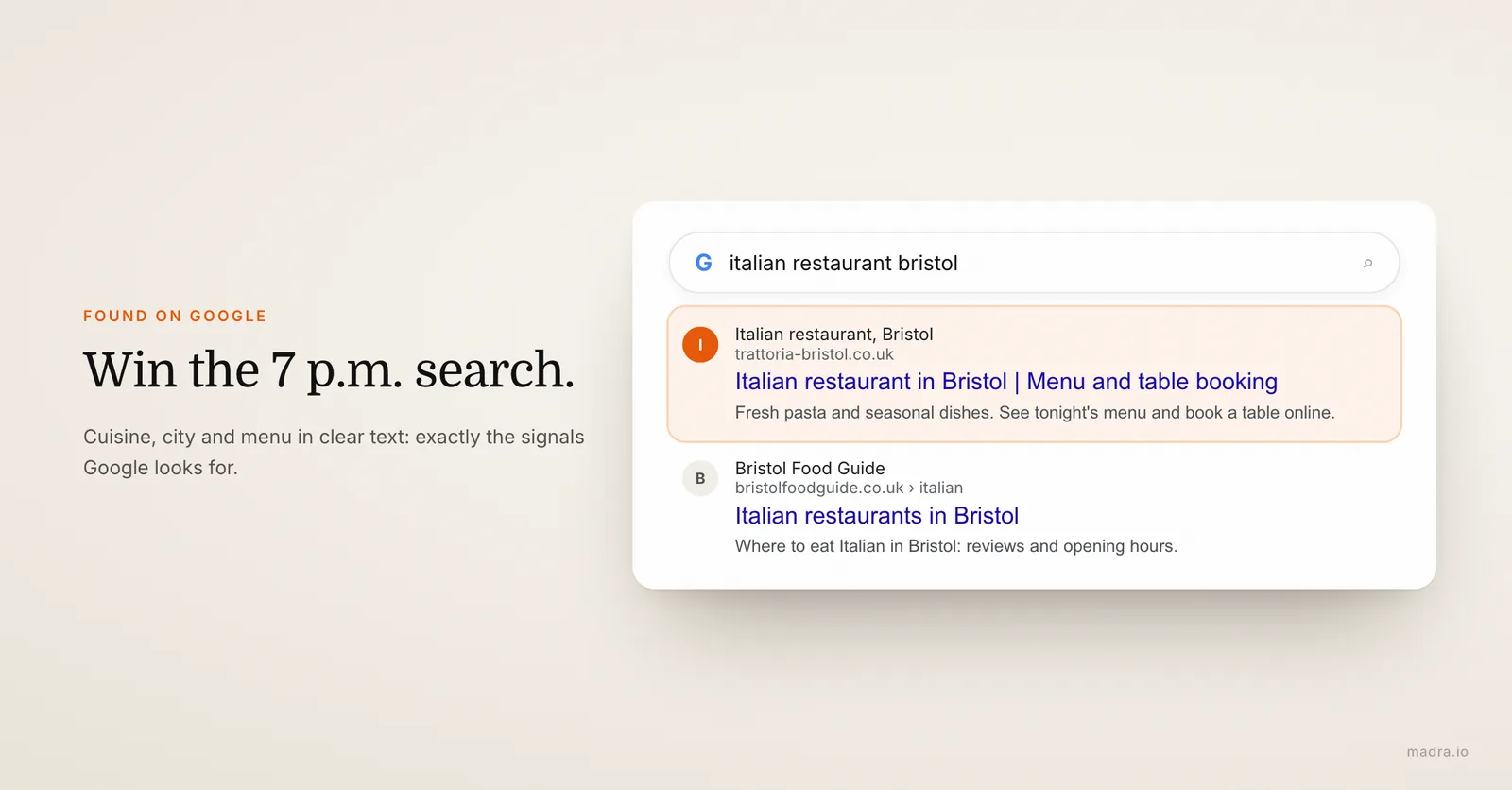
You do not need to fight national guides or the big aggregators over generic keywords. Your turf is local: "ramen Austin," "seafood restaurant Boston," "vegan dinner Brooklyn." On those queries, a website that lays out your cuisine, your city and your menu in clear text sends Google exactly the signals it is looking for to rank you. That is an edge the big platforms cannot take from you, because they are not you.
If you are still weighing the underlying case for a website over social media alone, we lay out every argument in our piece on why your business needs a website.
Online booking: taking back control from OpenTable and TheFork
The reservation is the moment a visitor becomes a cover. It is the most profitable element of your restaurant website, and also the one where the most money quietly leaks out.
The real cost of the platforms
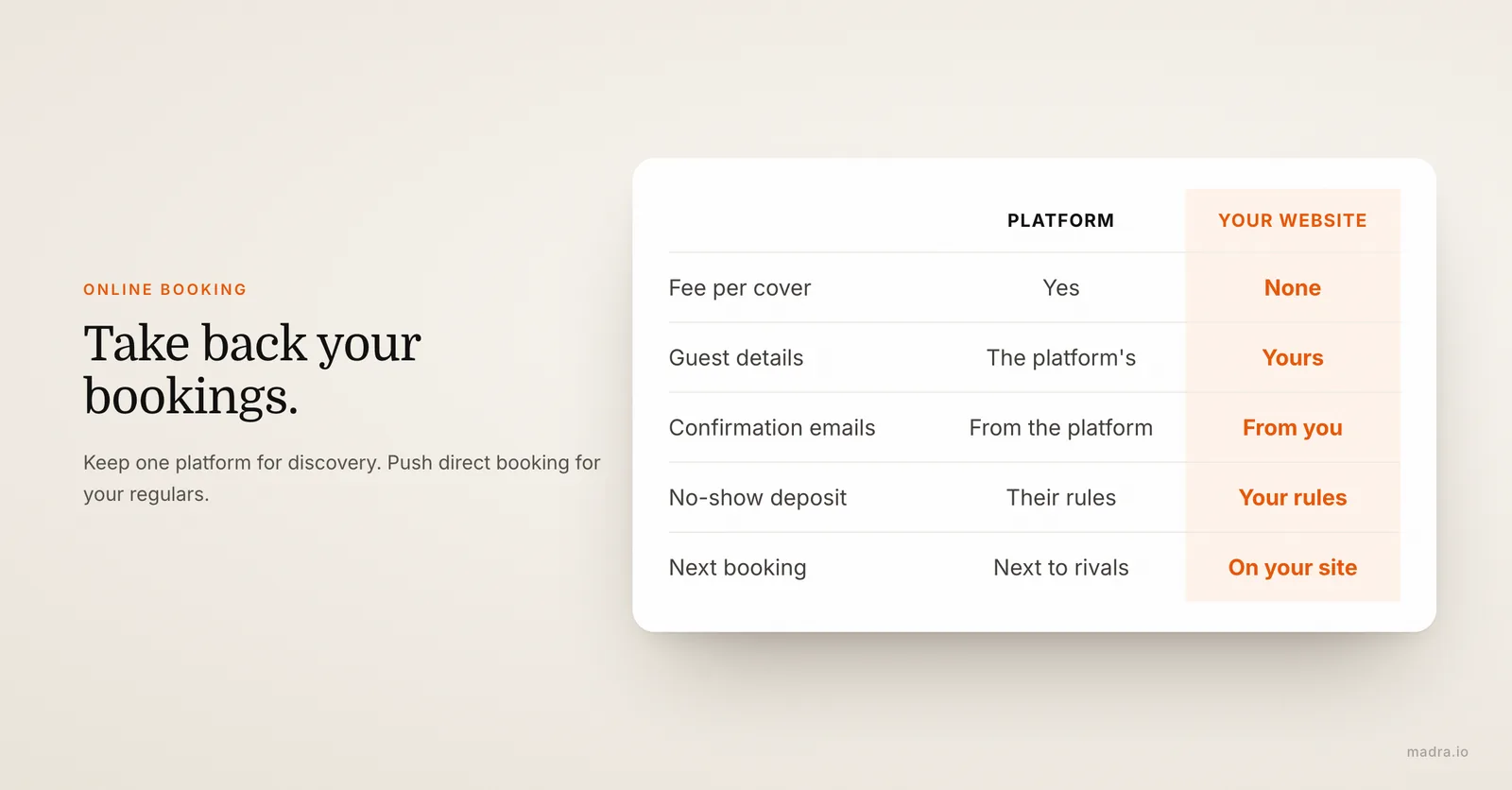
OpenTable, Resy and the rest bring visibility, no argument there. But that service has a price: a fee taken on every cover (or a monthly subscription), and, more importantly, a guest relationship that is not yours. The diner books "through OpenTable," gets their confirmation emails from OpenTable, and next time it is OpenTable they will open again, where your competitor is one tap away. You are paying for customers you may already have had.
The point is not necessarily to cut everything off overnight. It is to rebalance: keep one platform for discovery, and push direct booking through your own site and your Google profile for the regulars. Every direct reservation is a fee saved and a guest whose details you get to keep.
That last part matters more than the fee. When a guest books direct, you own the relationship. You can email them a "we miss you" offer in a slow month, invite them to a wine dinner, or let them know you have finally added the dish they asked about. On a platform, that audience belongs to the platform, and the next email they get may well be a promo for the bistro across the street. A direct booking channel is, quietly, the start of a customer list you control.
Which booking system belongs on your site
- The click-to-call button. On mobile, one tap dials your restaurant. The simplest option, and still the most effective for last-minute tables.
- The booking request form. The diner leaves a date, time and party size; you confirm. Zero commission, and you collect their contact details.
- The embedded widget. If you want a real-time reservation module, it slots cleanly into a page of your own site, under your own domain, not a platform's.
No-shows: charge a deposit
The no-show (the reservation that never shows up) eats margins, especially on weekends and large parties. A four-top that vanishes at 8 p.m. on a Saturday is a table you turned others away from, and a bill you cannot recover. An increasingly common defense: take a card hold or a small deposit at the time of booking, charged only if the table is a no-show without notice. It is socially accepted for tasting menus and groups of six or more, and it changes the economics of a full service. A booking system on your own website leaves you free to set up that safeguard exactly how you want, with your own cancellation window and your own wording, without depending on a platform's rules or its cut.
A small but real bonus: a clear, automatic confirmation and a friendly reminder the day before cuts no-shows on their own, before any deposit even comes into play. People forget; a well-timed message does not.
Want a restaurant website with direct, commission-free booking?
Fill in the form, send your menu and photos, and get your complete website in 24 hours. Hosting, domain and SEO included.
Your menu online: escape the PDF trap
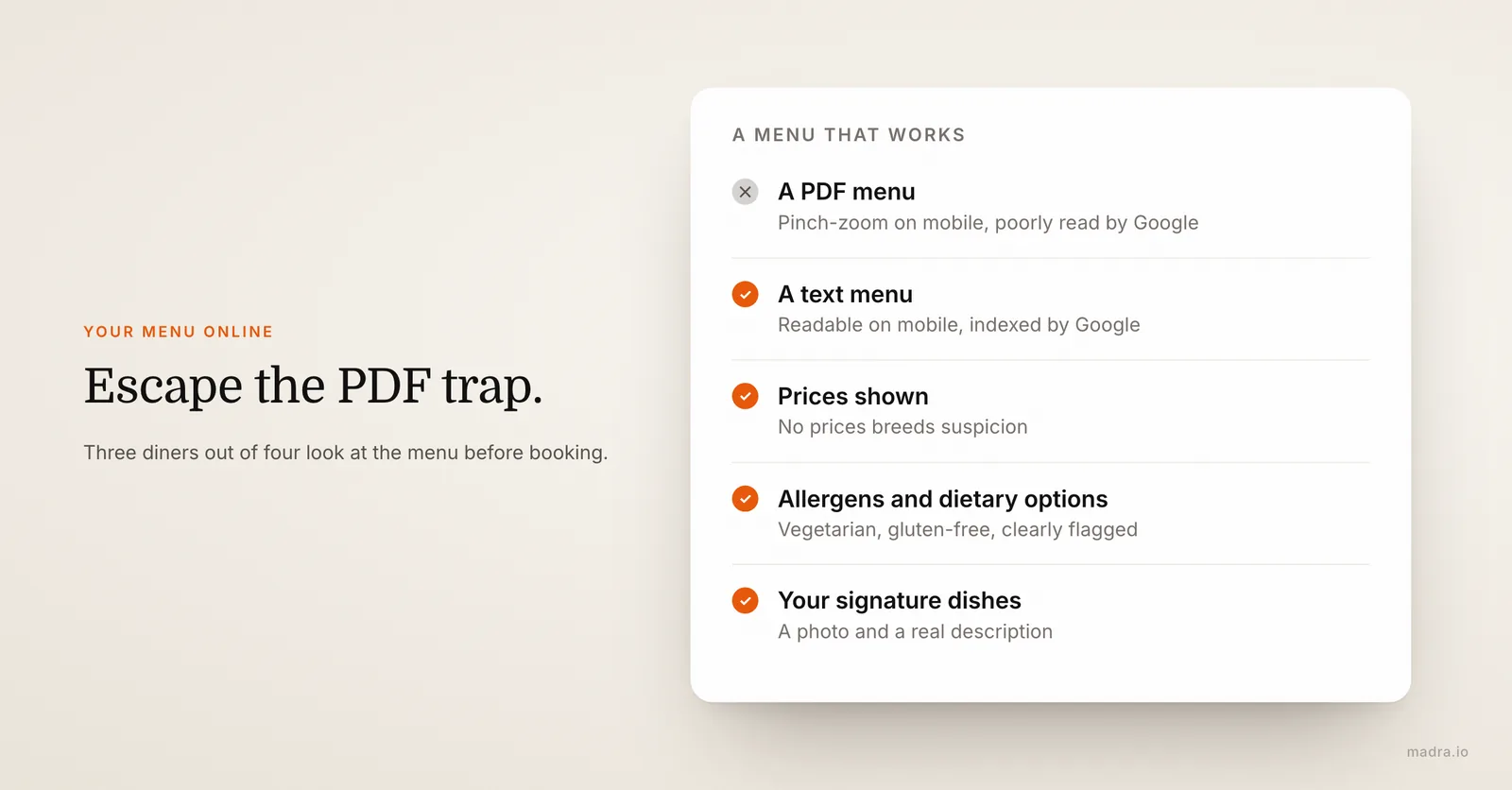
The menu is, by far, the most viewed page of a restaurant website. Three diners out of four look at it before booking. And this is exactly where most restaurant owners make the same mistake: posting their menu as a PDF.
Why the PDF costs you customers
A PDF is the worst of both worlds. On a phone it opens badly, forces the diner to pinch-zoom and drag around in every direction, and they give up. And on the search side, Google reads the contents of a PDF poorly. Your dishes, your specialties, your prices, everything that could make you surface on "duck confit Portland" stays invisible. You have the content, but it is locked in a format that neither the diner nor Google likes.
A text menu: readable and indexable
A menu built in HTML text reads perfectly on mobile, with no zooming, and becomes content Google indexes. Every dish, every category, becomes a chance to show up in a search. It is also far simpler to update: a daily special, a seasonal menu, a chef's suggestion can be changed in minutes instead of re-scanning a document.
This is the difference that decides whether your menu works for you. A restaurant menu is the most fluid thing on the whole site: ingredients run out, a supplier changes, prices move, a dish gets retired, the lunch board is different from dinner. A PDF freezes all of that the moment you export it, and a wrong or stale price online is worse than no price at all, because the diner notices it at the table. Text you can edit in a moment keeps the promise you make online and the plate you serve in sync.
A few good habits for an effective online menu:
- Show your prices. A menu with no prices breeds suspicion and scares off a chunk of your diners.
- Organize by category (starters, mains, desserts, set menus, drinks) for fast thumb-scrolling.
- Flag allergens and dietary options (vegetarian, gluten-free): it is a strong expectation, and clear allergen labeling is good practice diners now look for.
- Highlight your signatures. Your two or three standout dishes deserve a photo and a real description.
Photos and reviews: what actually fills the room
With menu and location being equal, two things tip a hesitant diner's decision: the photos and the reviews. Both play out on your website as much as on your Google profile.
Photos that make people hungry (and that are yours)
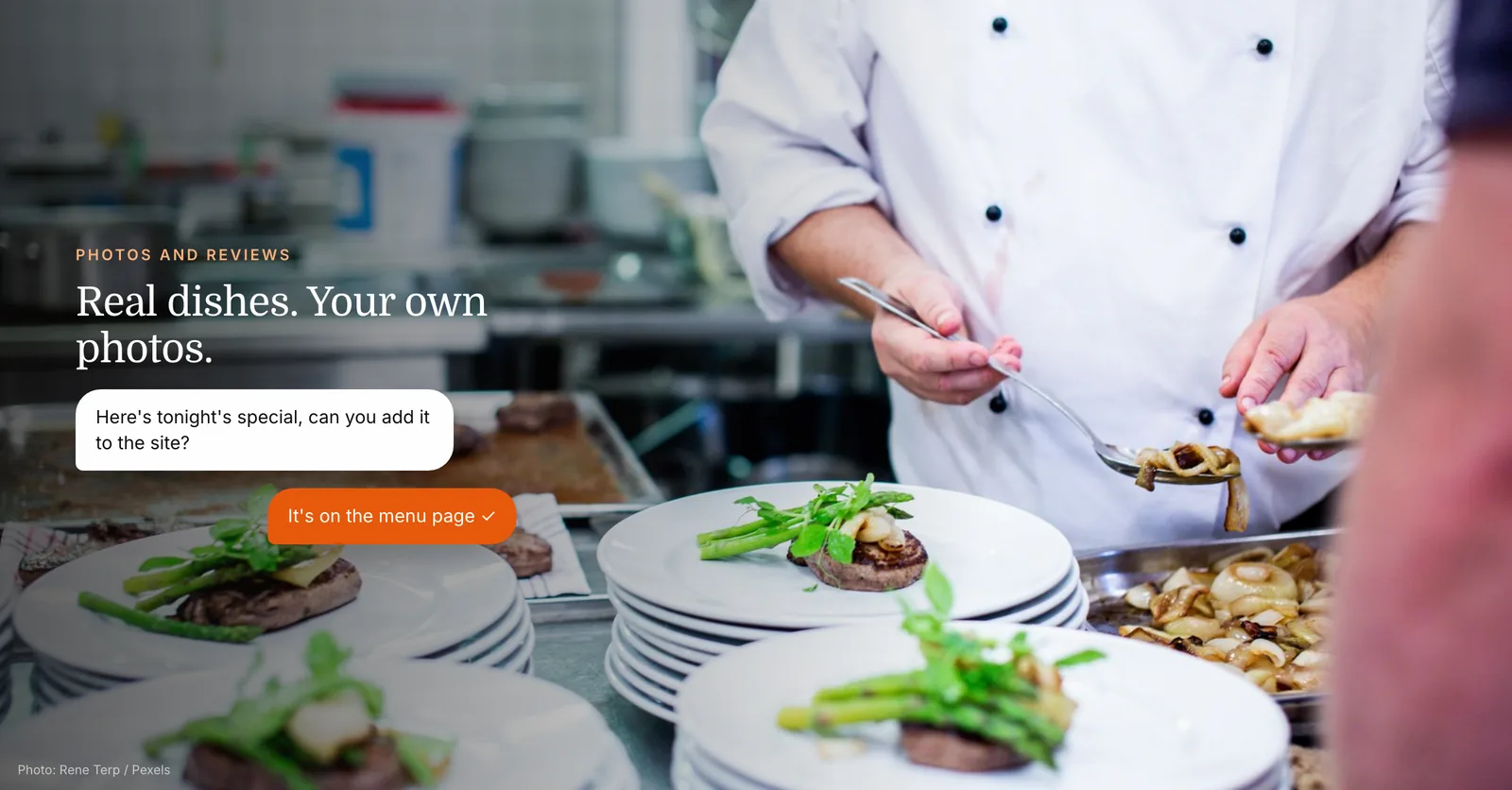
We eat with our eyes first. One great shot of your signature dish sells better than three paragraphs. The good news: you do not need a photographer at every service. A recent smartphone, natural light (near a window, during the day) and a well-plated dish are plenty. The one non-negotiable rule: real photos, your own. Stock images of generic pasta are spotted instantly and break trust, because the diner understands that is not what will land on their plate.
Reviews: your social proof
Google reviews have become a reflex before choosing a table. On your website, you can feature a hand-picked selection of your best reviews, ideally with the context (date night, business lunch, family brunch) that helps a new diner picture themselves there. You do not need to show fifty: five to eight authentic, well-chosen reviews reassure more than a long list. And on the Google profile side, get into the habit of replying to reviews, positive and negative alike: it is a signal diners and Google both appreciate, and it shows a restaurant that is alive.
The hardest part is getting reviews in the first place, and the trick is to make it effortless. Print a small QR code on the check or the receipt that opens your Google review form in one tap, and have your staff mention it naturally to a happy table. A steady trickle of fresh, recent reviews counts for far more in local ranking than a big pile of old ones, so the goal is a habit, not a one-time push. When a negative review does land, a calm, specific reply (not a defensive one) often does more for the next reader than the original complaint did against you.
What a restaurant website costs (and why it's not an online store)
This is the question every restaurant owner asks. The answer depends on the solution. For a full breakdown of every cost line, see our complete guide to how much a website costs. Here is the honest comparison, on the restaurant side, of the options in 2026.
| Solution | Price | Timeline | What's included | Your involvement |
|---|---|---|---|---|
| DIY (Wix, Squarespace) | $15-30/month | 2-5 days | Hosting, templates, editor | Everything: design, copy, photos, menu, SEO, maintenance |
| Freelance web designer | $800-2,500 (one-off) | 2-4 weeks | Custom design, integration | Provide content, approve, then handle menu updates yourself |
| Web agency | $2,000-8,000 (one-off) | 4-8 weeks | Design, development, basic SEO | Meetings, approvals, and often a fee per change |
| Madra (AI + human) | $29.90-79.90/month | 24 hours | Everything: design, menu, booking, SEO, hosting, domain, updates | Fill in a form (5 min) + send logo and photos |
A restaurant is not an online store
The classic mistake is to think about this like an e-commerce site. A restaurant does not need a catalog of hundreds of products or an inventory system. What it does need, and what few solutions handle well, is freshness. Your menu shifts with the seasons, you run a daily special, you have one-off closures and special nights. A successful restaurant website is, above all, a site that is fast and easy to keep current.
It also reframes what you are actually paying for. With an e-commerce store, the upkeep is products and stock. With a restaurant, the upkeep is the small, frequent stuff: a holiday closure, a new brunch sitting, a tweaked price, a fresh photo of tonight's plate. Those edits are tiny on their own, but they pile up across a year, and they are precisely the edits a DIY builder makes tedious and an agency bills by the hour. Judge a restaurant solution less on how pretty the first version looks and more on how painless the hundredth small change is.
That is where the math gets made. If you run a restaurant, your time is gold and your place is in the kitchen or on the floor, not fighting a website editor on a Sunday night. Twenty hours on Wix is twenty hours stolen from your service. An agency delivers quality, but the timelines and costs (including a fee for every change) rarely fit the reality of an independent operator. The appeal of a done-for-you service like Madra for a restaurant: a complete site in 24 hours, and a single message is enough to change your menu.
Your restaurant website live in 24 hours, without leaving the floor
Concretely, here is how building your restaurant website works with a done-for-you service like Madra:
Step 1 - You fill in a quick form (5 minutes). Your restaurant name, your cuisine, your address, your hours, your services (dine-in, takeout, delivery, private events). That is all it takes to get started.
Step 2 - You send your menu and photos. Your menu as text, or even a photo of your physical menu (we handle the formatting into readable HTML), your food photos, a shot of the room, your logo. No good photos yet? The site ships with consistent visuals and you swap in your own whenever you want.
Step 3 - AI builds your website. Architecture, online menu, copy, booking, optimization for local SEO and mobile: the bulk of the work is done automatically from your information and restaurant best practices.
Step 4 - Human review. A real person reads every page, checks the menu is readable, that the booking button works, that it looks perfect on a phone. This step is what sets it apart from a fully automated generator.
Step 5 - Your site goes live. Hosted, with your own domain name (myrestaurant.com), SSL on, SEO configured, and your Google profile linked. You approve it, request any tweaks, and you are off.
Changing your menu every season? Adding a daily special or closing for two weeks in the summer? It is included in the subscription: one message, and it is updated within 24 hours. To understand exactly how AI speeds all of this up, see our comparison of AI website builders. And if you know peers in other trades, we also have dedicated guides for tradespeople and coaches and therapists.
Ready to fill your dining room?
A professional restaurant website delivered in 24 hours, from $29.90/month. Your menu, your photos, your hours and your direct booking, all included.
Create my restaurant siteFrequently asked questions
Does a website replace my Google Business Profile?
No, the two work together. Your Google Business Profile captures local search ("restaurant + city", "near me") and shows your hours, your map pin and your reviews. Your website is what receives the click: it presents your full menu, your photos and your booking button. A profile with no website sends the diner to an OpenTable page or an unreadable PDF; a profile linked to a real website turns a search into a reservation.
Should I stay on OpenTable and Resy if I have my own website?
Platforms like OpenTable, Resy and TheFork bring visibility, but they take a fee on every cover (or a monthly subscription) and they keep the guest relationship. With a booking button on your own website, a share of your reservations becomes direct, fee-free, and you keep your guests' contact details. Many restaurateurs keep one platform for discovery and push direct booking through their own site and Google profile for regulars.
How do I handle a daily special or a menu that changes often?
That is exactly where a PDF falls apart. With Madra, menu changes are included in the subscription: you send your new menu or daily special by message, and it is updated within 24 hours, as real text that Google and your guests can read. No code to touch, no document to re-scan.
What if I do not have great photos of my dishes?
A recent smartphone and natural light (near a window, during the day) are enough for good food photos. What matters is that they are real and yours, not stock images of generic pasta. If you have nothing yet, your site ships with consistent visuals and you swap in your own photos whenever you have them.
Is a website worth it if I mostly do delivery (DoorDash, Uber Eats)?
Yes, and it is a margin lever. Delivery platforms often take around 30% commission on each order. A website with direct ordering or booking lets you steer your loyal customers toward a fee-free channel, while keeping the platforms to reach new ones. Your website becomes the home base for your regulars.
How much does a restaurant website cost and how long does it take?
With Madra, a complete restaurant website (menu, photos, booking, hours, Google map) is delivered in 24 hours from $29.90/month, with hosting, domain, SEO and updates included. For comparison, an agency charges $2,000 to $8,000 with a 4 to 8 week timeline, and a DIY builder like Wix demands dozens of hours of your own time.