How long does it take to build a website? The honest 2026 answer
You've decided you need a website. The next question is the one nobody answers straight: how long is this actually going to take? A weekend? A month? Until next quarter, when you finally have time to "sit down and do it properly"?
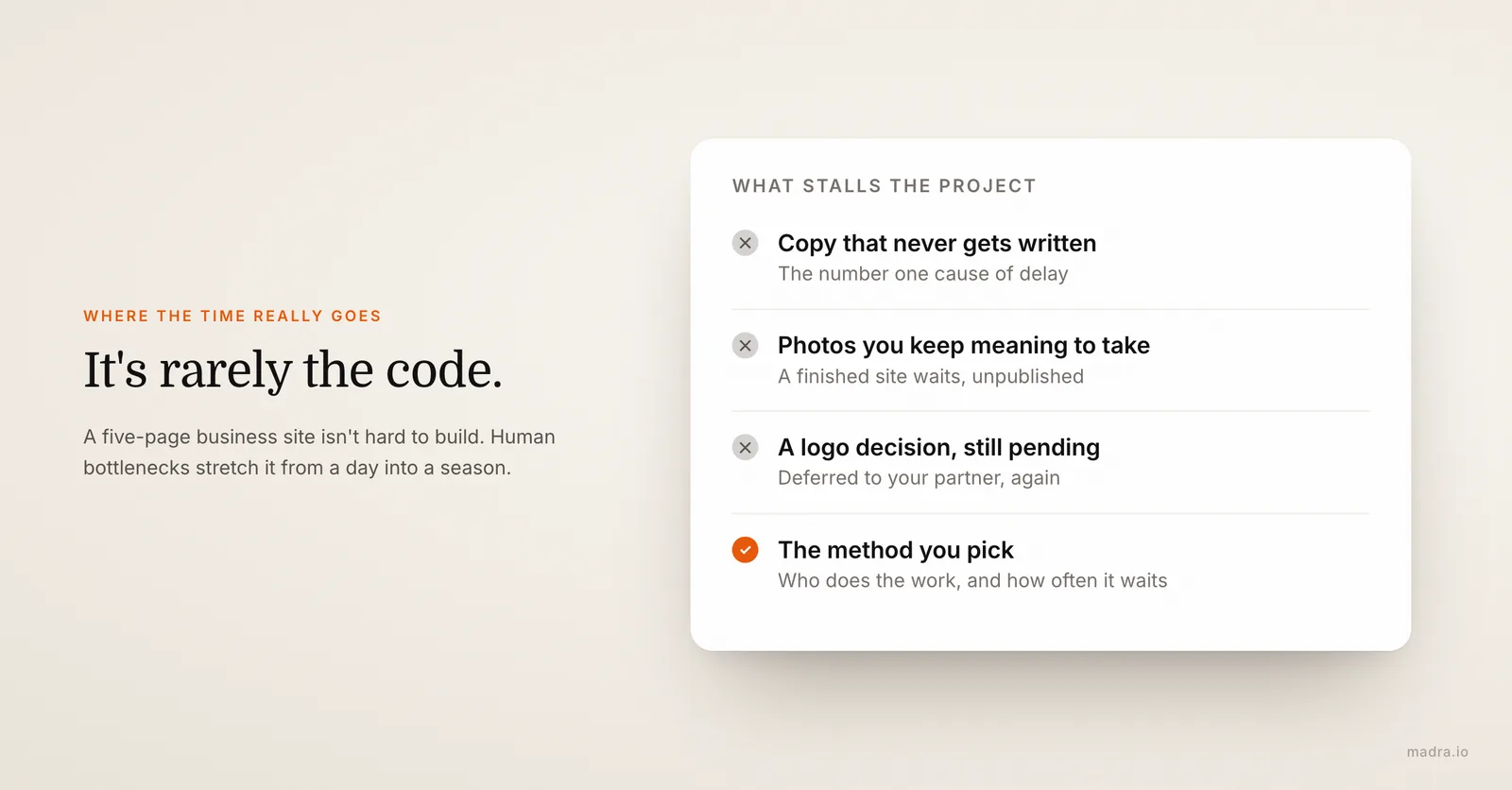
The honest answer is that the timeline has almost nothing to do with the website itself. A clean five-page business site is not hard to build. What stretches it from a day into a season is the method you pick and a handful of human bottlenecks that have nothing to do with code: copy that never gets written, photos you keep meaning to take, a logo decision you keep deferring to your partner.
This guide does something different from the usual "it depends" non-answer. It puts a real number on each route, DIY, agency, and AI plus a human reviewer, and explains where every day actually goes. Not the timeline printed on a sales page, but the one you'll live through. By the end you'll know which method matches your urgency, and exactly what to prepare so that whatever you choose moves faster.
The honest answer: it depends on the method
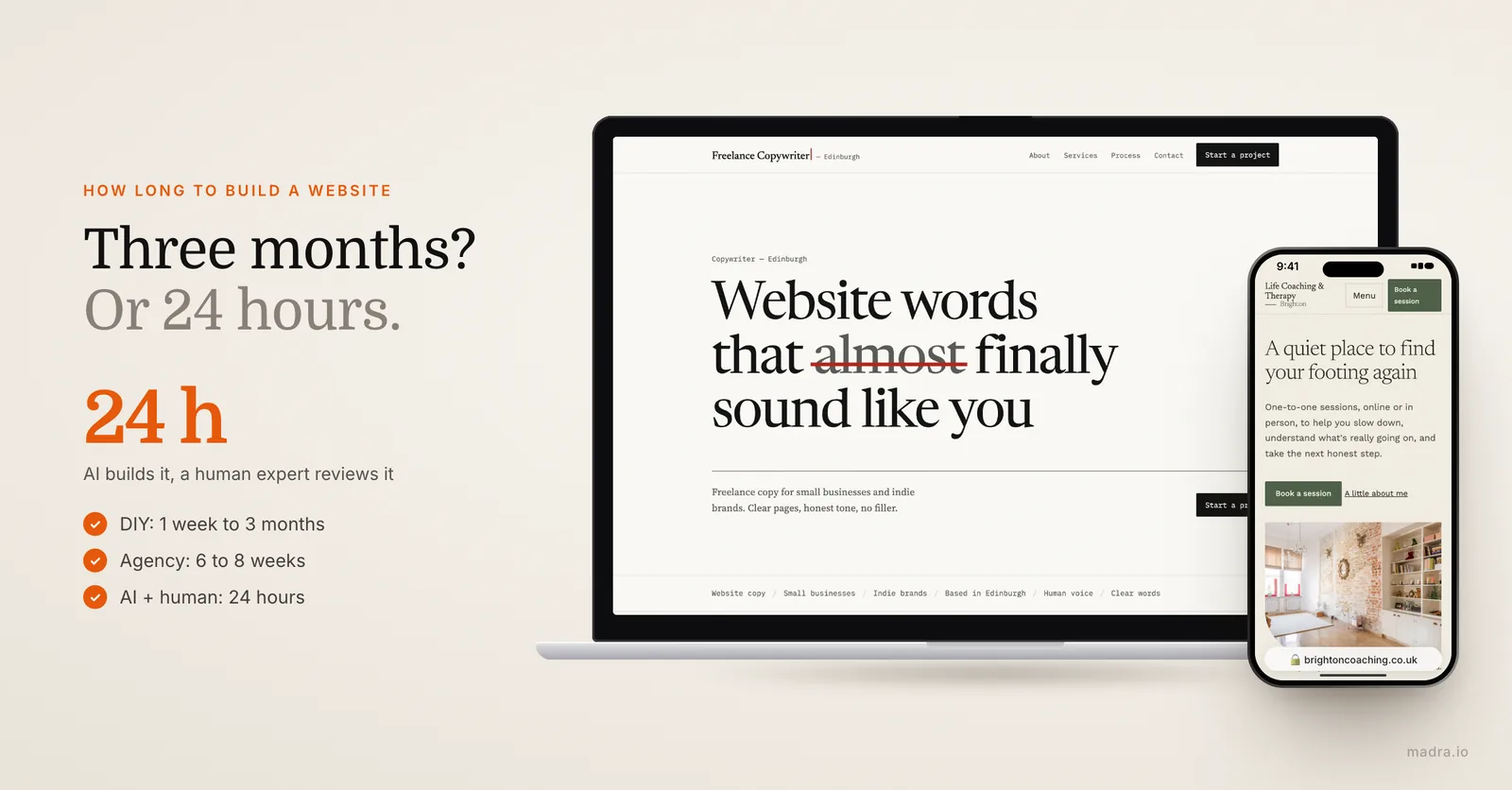
There is no single number, and anyone who gives you one is selling something. The time to build a website ranges from 24 hours to roughly three months, and the gap between those extremes is not about ambition or page count. It's about who does the production work and how many times the project has to stop and wait for a human.
Here's the honest overview for a standard business website of five to seven pages, the kind most freelancers, tradespeople and small businesses actually need. Read the "your involvement" column as carefully as the timeline, because that's where the real cost hides.
| Method | Realistic timeline | Hands-on hours from you | Where the time goes |
|---|---|---|---|
| DIY (Wix, WordPress) | 1 week to 3 months | 20-40 hours | Learning the tool, writing copy, design tweaking, SEO setup |
| Freelancer | 3 to 8 weeks | 5-10 hours (brief + approvals) | Finding them, briefing, waiting between their other clients, revisions |
| Web agency | 6 to 8 weeks | 5-12 hours (meetings + approvals) | Sequential phases that each wait on your sign-off |
| AI + human (Madra) | 24 hours | ~5 minutes (a form) | AI builds in minutes; a human reviews and polishes |
Two things to notice before we go deeper. First, the ranges above assume everything goes smoothly, which it rarely does on the first try. The DIY "one week" only happens if you already know the tool and your copy is written; otherwise it's the three-month end. Second, an online store is a different animal: for e-commerce, multiply each figure by two or three, because the catalog, payment setup and product descriptions add their own weeks.
So the real question isn't "how long does a website take." It's "how much of this timeline is me, and how much can I hand off?" Let's break down each route and find out.

DIY builders: why "a weekend" becomes three months
"Build a website in 5 minutes." Every DIY platform runs some version of that promise, and it's technically true: you can have a template live in five minutes. The trouble is that a template with placeholder text and stock photos isn't a website your customers will trust. The gap between "signed up" and "ready to send to a client" is where the weeks disappear.
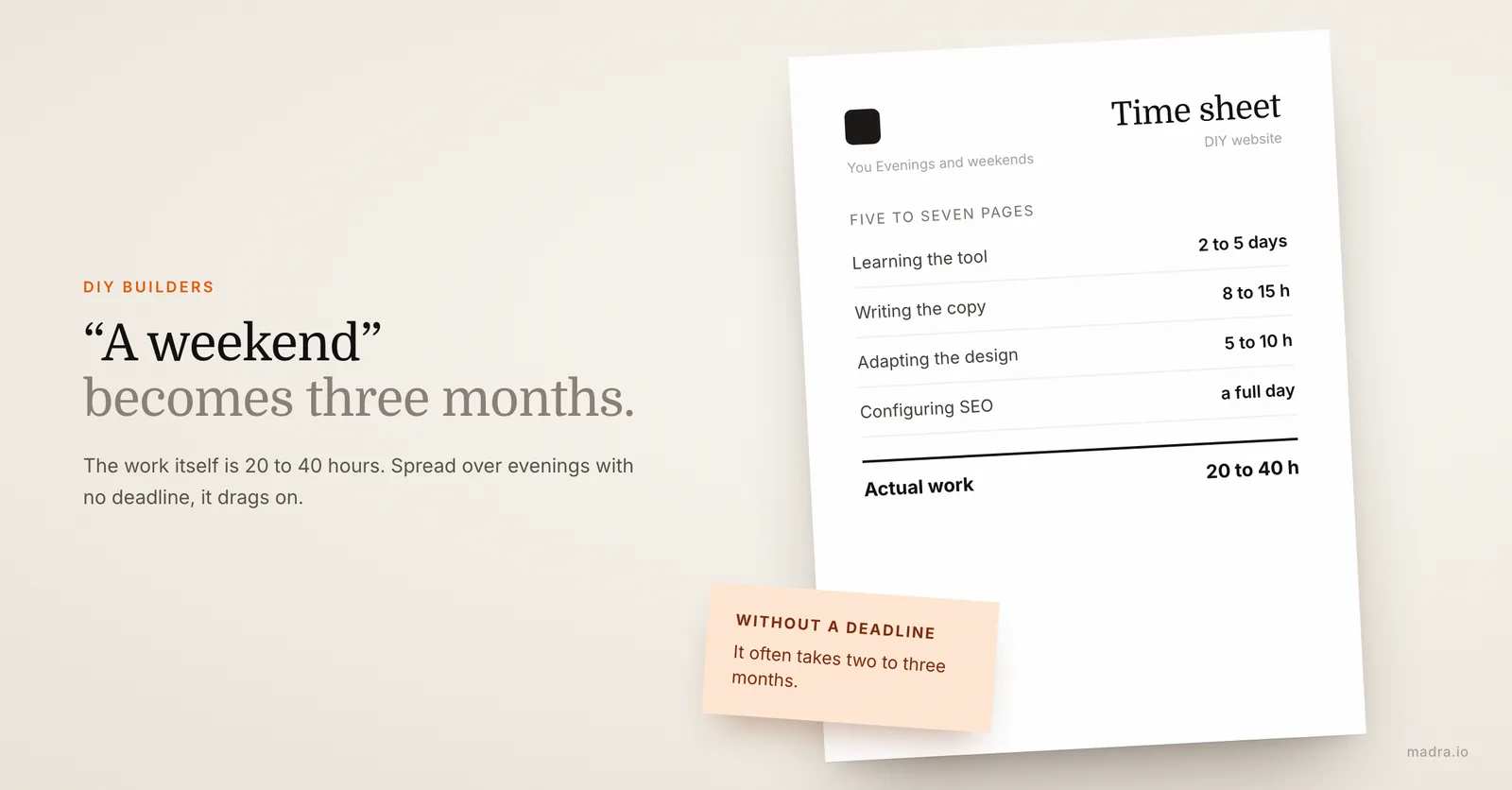
Learning the tool: 2 to 5 days
If you've never used a builder, budget two to five days just to get comfortable. Wix is gentler than WordPress, but even on Wix you have to understand sections, containers, responsive breakpoints and publish settings before anything looks right on a phone. WordPress adds hosting, a theme, a page builder plugin and the inevitable afternoon spent figuring out why an update broke your layout. None of this is hard, exactly. It's just hours you didn't plan for.
Writing the copy: 8 to 15 hours
This is the step everyone underestimates, and it's the biggest one. Writing genuinely good copy for five to seven pages, a home page, an about page, services, contact and legal text, easily takes 8 to 15 hours if you want words that actually convince a reader to contact you rather than generic filler. AI can give you a first draft in seconds, and our guide on building a website with AI walks through exactly how, but you still have to shape every line into your own voice and your own offer. A blank page has stalled more web projects than any technical bug ever has.
Adapting the design: 5 to 10 hours
Choosing a template takes ten minutes. Making it look like your business is the real work. Swapping in your colors, replacing every stock image, fixing the spacing that breaks when your headline is longer than the demo's, checking it all on mobile, that's 5 to 10 hours of fiddling. And if design isn't your instinct, you can pour in all those hours and still end up with something that reads as "a Wix template," which is the exact impression you were trying to avoid.
Configuring SEO: a full day if it's new to you
Title tags, meta descriptions, a sensible heading structure, alt text on images, page speed, connecting Google Search Console and submitting a sitemap. If those terms are unfamiliar, add a full day of learning and setup, and probably some second-guessing about whether you did it right. Skip this step and the site simply won't show up on Google, which makes the previous 30 hours close to worthless. A website nobody can find is a very expensive business card.
The verdict on DIY: the actual work is 20 to 40 hours. The problem isn't the hours, it's that they get spread across evenings and weekends with no deadline. A task with no deadline and a dozen small decisions doesn't take a week, it takes as long as you let it, and for a lot of people that means two to three months before the site is genuinely live.
Agencies (and freelancers): why it takes 6 to 8 weeks
Hiring someone trades your hours for a budget, and on paper you get a professional site without touching a single setting. In practice, both freelancers and agencies run into the same structural problem: a website built for you is a sequence of steps that keep stopping to wait for you. Most of the calendar is waiting, not working. Here's where the weeks actually go.
The freelancer route: 3 to 8 weeks
Before anything is built, you have to find the right person, which means browsing profiles on Upwork or Fiverr, requesting quotes, comparing portfolios and reading reviews. That's 3 to 7 days on its own, and if your first pick falls through you start over. Then comes the brief: a good freelancer needs to know what you want, and since most people don't know precisely, the back-and-forth to scope the project runs one to two weeks.
Actual production takes one to three weeks, but rarely full-time, because you are one of several clients and your project waits its turn. Then the revisions: "the blue is too dark," "can we move this section," "actually, different photo." Most quotes include two or three revision rounds; past that it's billed extra or it simply drags. Add it up and from first search to live site you're realistically looking at 3 to 8 weeks, and the timeline depends as much on how fast you reply as on how fast they work.
The agency route: a structured 6 to 8 weeks
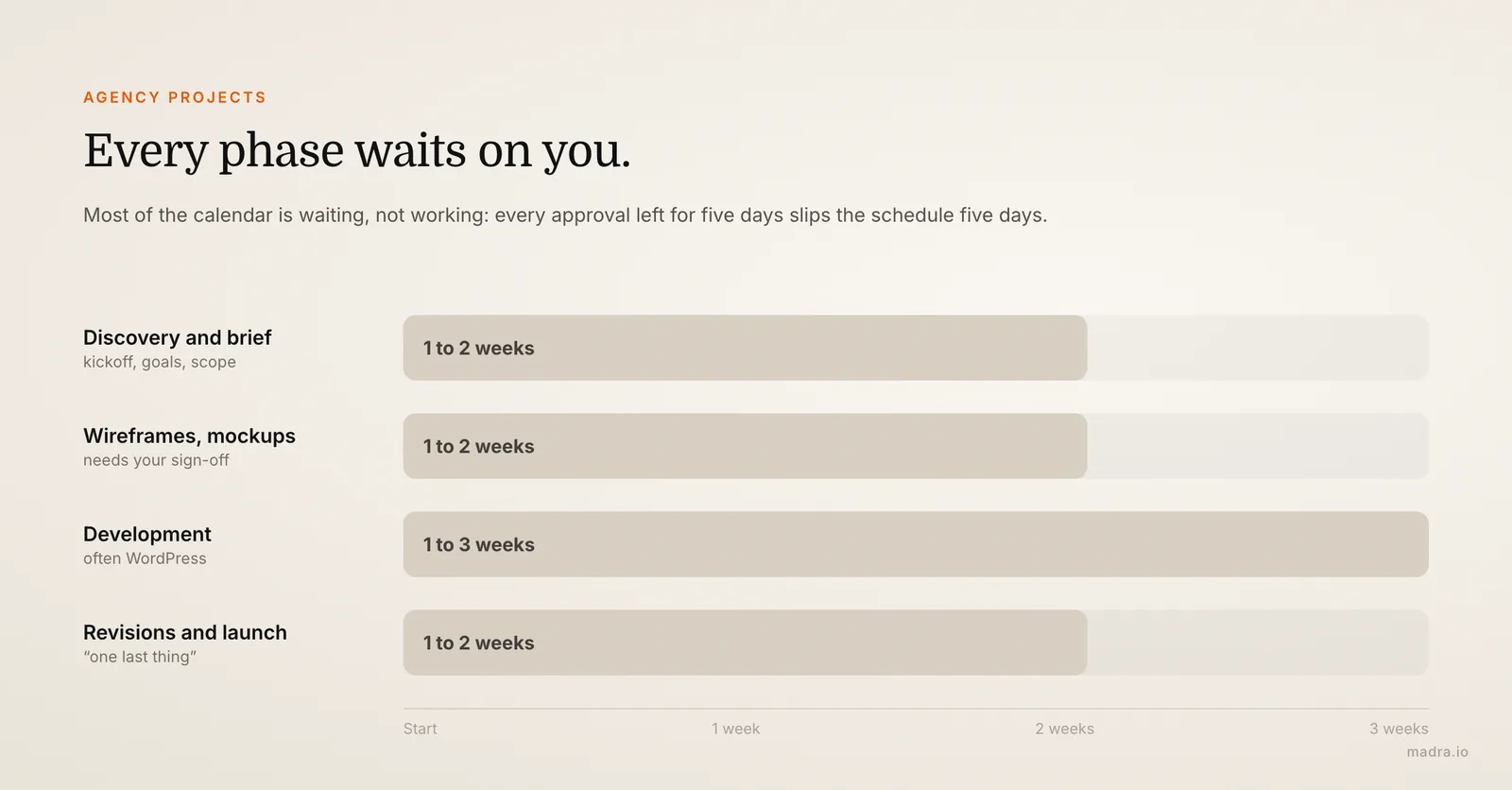
Agencies are more thorough, and that thoroughness is exactly why the calendar stretches. A standard business-site project moves through phases, and each one ends with an approval gate where the work pauses until you respond:
- Discovery and brief (1 to 2 weeks): kickoff meeting, competitor look, goals, technical scope. Some agencies write a 20-page spec before a single line of code.
- Wireframes and mockups (1 to 2 weeks): the skeleton of each page, then the visual design. Both need your sign-off.
- Development (1 to 3 weeks): building the design out, often on WordPress with a custom theme. Quality work, but each feature takes time to implement and test.
- Content integration and testing (1 to 2 weeks): loading copy and images, cross-browser checks, bug fixes. This is usually where someone realizes the copy isn't actually ready.
- Revisions and launch (1 to 2 weeks): final tweaks, final approval, going live, plus the inevitable "one last thing."
Here's the part the timeline never shows: much of it is dead time on your side of the gate. Leave an approval email for five days and the schedule slips five days. Request a major change in week four and the clock effectively resets. That's how a project that involves maybe 15 hours of your attention spreads across six to eight weeks of wall-clock time.
A realistic total for a business website at an agency is 6 to 8 weeks, and the budget follows: typically $2,000 to $10,000 depending on complexity and the agency's reputation. For the full money side, see our breakdown of how much a website costs. The quality is real. For a small business that mostly needs to be found on Google and look credible, it's often more time and money than the job requires.
AI + human: 24 hours, and what actually happens in them
If a freelancer needs weeks and an agency needs months, how does the same business site get delivered in 24 hours without cutting corners? The answer is that the 24 hours are spent on completely different things. In the traditional routes, most of the calendar is a person doing production by hand and everyone else waiting on approvals. Remove the by-hand production and the waiting, and a day is plenty.
Why minutes, not weeks
The slow part of every traditional build is a human performing each step in sequence: structuring the pages, writing the first draft of every paragraph, choosing and arranging layouts, coding the design, wiring up the SEO basics. Each of those is hours of skilled but mechanical work. AI does the same production in minutes. The two weeks a freelancer spends on architecture plus copywriting plus a first design is compressed into well under an hour.
That compression isn't the point on its own, though, because raw AI output is not a finished website. What the speed actually buys you is time for the part that matters: a human checking, correcting and polishing the result instead of grinding out the first 90% by hand. The machine handles the volume; the person handles the judgment.
What the 24 hours actually contain
Step 1 - You fill out a short form (about 5 minutes). What you do, who you serve, your contact details, a sense of the look you want. No 20-page spec, no two-hour scoping call. Short, honest answers are enough to start.
Step 2 - You send your logo and any visuals. Team photos, examples of past work, whatever you already have. If you have nothing, the site is delivered with coherent stand-in visuals and you swap in your own whenever you're ready, so a missing photo never blocks the launch.
Step 3 - AI generates the site (minutes). Page architecture, copy, design and technical SEO are produced automatically from your answers and the conventions of your industry. This is the step that used to be two weeks of someone's time.
Step 4 - A human expert reviews everything (the bulk of the day). This is where the real hours go. Someone proofreads the copy, adjusts the design, checks that every page looks right on a phone, verifies the SEO and tests the site. This review is the entire difference between a raw "AI site" and something genuinely professional, and it's why the result holds up where a fully automatic generator wouldn't. To see how AI builders compare on this exact point, here's our look at the best AI website builders.
Step 5 - Your site goes live within 24 hours. Hosted, on your own domain, with SSL active and SEO configured. You review it, ask for any tweaks, and it's online.
The result is a professional website in 24 hours that would have taken three to eight weeks the traditional way. Not because anything was skipped, but because AI erased the hours of manual production and there were no approval gates sitting idle in between.
Need your website online fast?
Fill out the form in 5 minutes, get a professional site reviewed by a human in 24 hours. Hosting, domain and SEO included, from $29.90/month.
A realistic week-by-week timeline for each method
Ranges are honest, but they're abstract. What does week one actually look like? When do you write the copy, when do you approve the design, when does the site go live? Here's the calendar you can realistically expect on each route, for a standard five to seven page business site, assuming you reply to things within a day or two.
DIY: the focused two-week sprint
Week 1: you sign up, pick a template, and spend three or four evenings learning the editor: sections, containers, mobile preview, publish settings. By the weekend you have a skeleton with placeholder text and a rough color scheme. Week 2: the hard part. Block a full weekend day for copy, then two evenings to swap in your images, fix what breaks on mobile, and set up title tags, meta descriptions and Google Search Console. If you hold that pace, you launch at the end of week two. The catch: this schedule only survives if you treat it like a project with a deadline. Skip the copywriting weekend once and you're back on the three-month plan described above. If you take this route, drafting your text with AI first is the single biggest accelerator: our guide to creating a website with AI shows how to get a usable first draft in an afternoon instead of ten hours.
Freelancer: three to six weeks, gate by gate
Week 1: searching, shortlisting, requesting quotes, checking portfolios. Week 2: the brief, a scoping call, and sign-off on the page structure. Weeks 3 and 4: production, interleaved with their other clients; somewhere in the middle you approve a design mockup and deliver your content. Weeks 5 and 6: revision rounds, final content fixes, launch. Every gate in that sequence waits on you: reply same-day and six weeks can become four, sit on an approval for a week and it becomes eight.
Agency: two to four months of phases
Month 1: kickoff meeting, discovery, competitor review, wireframes, and your first approval gates. Month 2: visual design, then development once you've signed off. Month 3: content integration (this is where unwritten copy stalls everything), cross-browser testing, first full revision round. Month 4: the buffer nobody puts in the proposal: final approvals, the "one last thing" list, DNS and launch. Well-run projects finish in month two or three; the fourth month exists because most projects aren't perfectly run on either side.
AI + human: the 24 hours, hour by hour
Hour 0: you fill in the five-minute form and send your logo. The first hour: AI generates the page architecture, copy, design and technical SEO. Hours 1 to 20: a human expert reviews every page: copy corrected, design tightened, mobile checked, SEO verified. Hour 24: the site is live on your domain with SSL active. There are no gates because there's nothing for you to approve mid-build: you review the finished site, not wireframes of it.
Side by side, with the money attached (for the full cost breakdown, see our guide to how much a website costs):
| Method | Real timeline | What eats the time | Indicative cost |
|---|---|---|---|
| DIY (Wix, WordPress) | 1 to 2 weeks of focused work | Learning the tool, writing copy, design tweaks, SEO setup | $10 to $40/month, plus 20-40 hours of your time |
| Freelancer | 3 to 6 weeks | Finding the right person, briefing, waiting between their clients, revision rounds | $800 to $3,000 one-off |
| Web agency | 2 to 4 months | Sequential phases, approval gates, content integration | $2,000 to $10,000+ one-off |
| AI + human review (Madra) | 24 hours | Human review and polish of the AI output | From $29.90/month, hosting, domain and SEO included |
Why website projects run late
Almost every website estimate you'll ever receive is a best-case number. Not because anyone is lying to you, but because quotes are written for the project where the content is ready, every email gets answered within a day, and nobody changes their mind halfway through. Real projects fail all three assumptions, and each failure has a predictable price in weeks. Here are the mechanics.
The approval-gate arithmetic. A typical freelancer or agency project has four to six moments where work stops until you sign something off: the brief, the sitemap, the wireframes, the design, the pre-launch review. Each gate isn't a one-day event. You take two or three business days to look at it properly, then the provider takes another two or three to slot your feedback into their schedule. That's roughly a week per gate. Five gates means over a month of calendar time during which nothing is being produced at all. This, more than slow work, is why a 40-hour project occupies a 10-week calendar.
Scope creep, the quiet one. The project starts as five pages. Then "while we're at it" arrives: a blog, a booking module, a second language, three more pages for services you forgot to mention. Every addition requested mid-project costs two to three times what it would have cost in the original brief, because it has to be designed, built and tested against pages that were already finished. Two rounds of "while we're at it" can add three weeks and a four-figure invoice.
The content dependency. Providers can build everything except your words and your photos. When those arrive late (and they almost always do), the finished shell sits waiting. It's entirely normal for a site to be 90% complete for a month because the about-page text is "almost done". The build was never the bottleneck; the paragraph was.
You are not their only client. A freelancer typically juggles three to six projects at once; an agency runs a dozen. When you send feedback, it doesn't get handled that afternoon, it gets queued. Miss your slot in their week and your revision waits for the next one. This is nobody's fault, it's how service businesses stay solvent, but it means every round trip costs days even when both sides are diligent.
The pre-launch spiral. The last 5% of a website generates 50% of the anxiety. "One last thing" becomes a list, the list becomes a second revision round, and a site that was ready in week six goes live in week nine, unchanged in any way a customer would notice.
None of this is incompetence. It's the structure of hand-made production separated by human gates. Which is exactly why the 24-hour model works: remove the manual production and the gates, and there's nothing left to run late.
What really slows YOU down (and how to speed it up)
Whichever route you take, the same three things drag projects out, and not one of them is technical. The build itself is fast in every scenario above. What isn't fast is you, specifically your content, your photos and your decisions. The good news: each of these has a concrete fix, and fixing them up front is the single biggest lever you have on the timeline.
Content that isn't ready
This is the number one cause of delay in web projects, full stop. The design is done, the build is progressing, and then everything stalls because the home-page copy is still "being written." A site can sit 95% finished for three weeks waiting on a single paragraph you keep not writing. The provider can't move; you're the bottleneck and you may not even realize it.
How to speed it up: before you start anything, write down three things. Your value proposition in one sentence (what you do, for whom, and why you). A bullet list of your services with a line of description each. Your full contact details. That's the minimum to unblock a build, and the rest can be refined after launch. Don't wait for perfect words, get the substance down and improve it live.
Photos you keep meaning to take
"I'll get proper photos done soon" is a sentence that has delayed websites by months. Waiting on a photographer, or on a free weekend to shoot your own, is a classic way to let a finished site sit unpublished. Real photos matter, a generic stock image is spotted instantly and quietly erodes trust, but a missing photo should never hold the whole project hostage.
How to speed it up: a recent smartphone in good natural light handles most business photography perfectly well, so you can shoot a usable set in an afternoon. And if you genuinely have nothing today, pick a method that launches with coherent placeholder visuals and lets you replace them later. Live with a stand-in beats invisible with a plan.
Decisions you keep postponing
"I'm not sure if I want five pages or seven." "I haven't picked between these two logos." "I want to wait for my partner's opinion." Every open decision freezes the project, and postponed decisions don't resolve themselves, they pile up until the whole thing feels too big to face. Multiply that by a few rounds of "change the button color, no, change it back" and you can double a project's length over details no customer will ever notice.
How to speed it up: give yourself a rule, every decision gets made within 24 hours, and batch your feedback into one round instead of trickling it out. Before each change, ask: "will this win me one more customer?" If the answer is no, let it go. An imperfect site that's live always beats a perfect one that only exists in your head.
A web project that drags is almost never a technical problem. It's a decision and content problem. Which is the real reason the AI-plus-human route is fast: it asks you for the fewest decisions and the least prepared content up front, and removes the approval gates where everyone else loses their weeks.
How to prepare so your website ships fast
Everything in the previous two sections points at the same conclusion: the delays live on your side of the project, so the fixes do too. One focused afternoon of preparation, before you touch a builder or email a freelancer, removes most of the waiting from every method on this page. Here's the pack to assemble, in order of impact.
- Your offer in one sentence. What you do, for whom, and why you rather than the next result on Google. This is the hardest item on the list and the one everything else hangs on: the home-page headline, the brief, the AI prompt. Write three versions, pick one, move on.
- Your services, as a plain list. One bullet per service, one line of description each. No prose, no polish. A builder, a freelancer or an AI can turn a list into pages; nobody can turn silence into pages.
- Your practical details, complete. Address, phone, email, opening hours, service area, social profiles. Trivial to gather, and the single most common thing found missing at integration time.
- Your logo in its original file. SVG or a high-resolution PNG, not a screenshot of your business card or a photo of your van. If you only have a low-quality version, say so up front instead of letting it surface in week four.
- Ten to fifteen photos in one folder. Your work, your space, your team, your products. A recent phone in daylight is genuinely enough. Done in an hour, and it kills the "waiting for the photographer" delay before it starts.
- Two or three websites you like, with one sentence on why. "I like the colors here, the layout there." This beats a thousand adjectives like "modern" and "professional" and cuts an entire round of design guessing.
- The open decisions, closed. Domain name chosen, list of pages fixed, and one named person who approves things within 24 hours. A committee of two doubles every gate in the project.
- Access to your domain, if you already own one. Know which registrar it's at and be able to log in. DNS access panic is a classic way to lose the launch week.
With this pack in hand, every timeline in this article shrinks: the DIY two-week sprint becomes realistic instead of optimistic, a freelancer skips a week of scoping back-and-forth, and an agency's discovery phase gets shorter. It also changes how you evaluate tools: once your content is ready, the differences between platforms get much easier to judge, which is exactly what our comparison of the best AI website builders in 2026 is for. And on the AI + human route, the five-minute form really does take five minutes, because every answer is already sitting in your folder.
Got the pack ready? Then 24 hours is all it takes.
Fill out the form, send your logo and photos, and get a professional site reviewed by a human expert, live on your domain tomorrow. From $29.90/month, everything included.
Get your website online in 24 hours
If you've read this far, the takeaway is simple. The timeline to build a website in 2026 runs from 24 hours to three months, and the deciding factor isn't the website, it's how much of the work lands on you and how many times the project has to stop and wait. DIY costs little money but 20 to 40 of your own hours, and slides for months without a deadline. A freelancer or agency delivers polished work in 3 to 8 weeks for $800 to $10,000, as long as communication stays tight.
If what you actually want is a professional result without the wait or the workload, that's the gap Madra is built to fill. AI does the production in minutes, a human expert reviews and polishes every page, and your site is live on your own domain within 24 hours, hosting, SSL and SEO included, from $29.90/month. Your only job is a five-minute form and sending whatever logo and photos you have. Need it later changed? A message, and it's updated, no editor to wrestle on a Sunday night.
Whatever you decide, prepare your copy, your photos and your decisions before you begin, and every method on this page goes faster. And if a website is part of a bigger question, our guide on why have a website at all is a good next read.
Your website live within 24 hours?
A professional site, reviewed by a human, delivered in 24h from $29.90/month. Hosting, domain and SEO included, no long-term commitment.
Create my site nowFrequently asked questions
How long does it take to build a website?
It depends entirely on the method. A DIY builder like Wix or WordPress realistically takes one to four weeks of your own time, and often slides to three months when life gets in the way. A freelancer takes three to eight weeks. A web agency takes six to eight weeks for a standard business site. A service that pairs AI with a human reviewer, like Madra, delivers a finished professional site in 24 hours because the production no longer happens by hand.
Can you really build a website in 24 hours?
Yes, as long as the production is not done by hand. AI generates the structure, copy and design in minutes rather than the days a person would spend, then a human reviewer checks every page, fixes the copy, tightens the design and verifies the site works on mobile. You spend about five minutes on a form and send your logo. The 24 hours is mostly the human review, not the building, which is why the quality holds up.
Why does a DIY website builder take so much longer than it promises?
The five-minute promise covers signing up and picking a template, not finishing a site. The real time goes into learning the tool (two to five days), writing copy for five to seven pages (8 to 15 hours), adapting the template to your brand (5 to 10 hours) and configuring SEO (a full day if you have never done it). Spread across evenings and weekends with no deadline, that 20 to 40 hours of work commonly stretches across two to three months.
Why do web agencies take six to eight weeks?
Agencies run sequential phases that each wait on your approval: discovery and brief (one to two weeks), wireframes and design mockups (one to two weeks), development (one to three weeks), content integration and testing (one to two weeks), then revisions and launch (one to two weeks). Much of the calendar is waiting, not working. Every approval email you leave for five days slips the schedule by five days, and a major change resets the clock.
What actually slows down a website project the most?
It is almost never the technology. The three biggest delays come from your side: content that is not ready (the number one cause), photos you keep meaning to take, and decisions you postpone. The build can be finished while a single home-page paragraph sits unwritten for three weeks. The fastest method is the one that needs the fewest decisions and the least content from you up front.
How long does an e-commerce website take compared to a business site?
Roughly two to three times longer. A standard five to seven page business site takes the timelines above, but an online store adds a product catalog, payment setup, shipping rules and a product description for every item. DIY with Shopify or WooCommerce runs two to six weeks, a freelancer four to ten weeks, and an agency two to six months. The extra time is the catalog and the logistics, not the homepage.
How long does it take to build a website with AI?
A raw AI generator produces a draft site in minutes, but that draft still needs hours of correcting: copy that sounds generic, layouts that break on mobile, SEO left half-done. A service that pairs AI generation with a human expert review, like Madra, ships the finished, corrected site within 24 hours. The AI handles the production volume in minutes and the human review fills most of the remaining day, which is where the professional quality comes from.
How long before a new website shows up on Google?
Getting indexed usually takes a few days to a few weeks once the site is live and submitted to Google Search Console. Ranking is a different clock: for your own business name, expect days; for competitive search terms, expect three to six months of gradual progress, faster if the SEO basics were configured at launch. This is the strongest argument against slow builds: every week your site is not live is a week the Google clock has not started.
What should I prepare before starting a website project?
Five things, roughly one afternoon of work: your offer in one sentence, a bullet list of your services, your complete contact details and opening hours, your logo in its original file, and ten to fifteen photos gathered in one folder. Add two or three example sites you like and make the open decisions (domain name, list of pages, who signs off). This pack removes the number one cause of delay, unready content, on every method from DIY to agency to AI.