Real estate agent website: the one that wins listings, not just clicks

A seller decides who gets their listing long before the appointment. They saw your sign on a neighbor's lawn, or a friend mentioned your name, and the very next thing they did was type it into Google. What they find in those thirty seconds either books the meeting or quietly hands it to another agent.
That is the real job of a real estate agent website. It is not a digital business card and it is not a second-rate copy of the big property portals. It is the place where a stranger becomes convinced that you are the person who knows their neighborhood, sells homes like theirs, and answers the phone.
This guide covers what buyers and sellers actually look for on a website for realtors, the features that capture leads instead of losing them, the mistakes that make good agents look amateur online, and the honest real estate website cost for every method, from doing it yourself to hiring an agency to letting AI plus a human expert build it overnight.
Why portals are not enough: the case for your own website
The objection every agent raises: "My listings are already on the portals. Why do I need a website?" Because portals and your website do two different jobs, and only one of them builds your business.
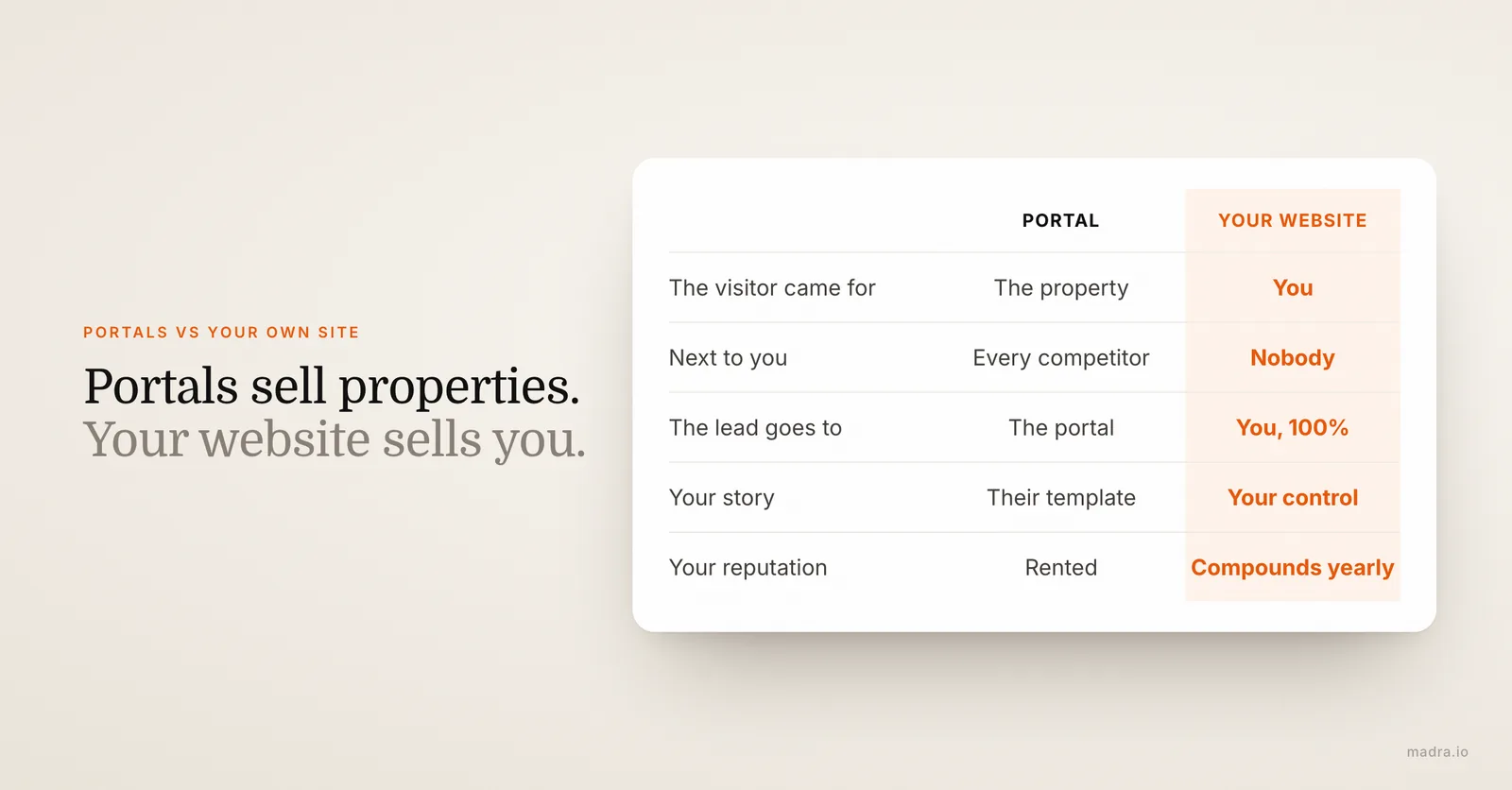
On a portal, you are a thumbnail in a grid next to every competitor in your zip code. The visitor came for the property, not for you. When they inquire, the lead often goes into the portal's machine, gets sold to whichever agent pays for that area, and your name is interchangeable with the next one. You are renting visibility on someone else's land, at their price, under their rules.
Your own website flips that. It is where people go to evaluate you: sellers deciding who gets the mandate, buyers checking whether you seem trustworthy, past clients sending referrals a link. It is the only place online where you control the story, keep 100 percent of the leads, and compound your reputation year after year instead of paying rent on it. The general argument applies to every business, and we laid it out in 8 concrete reasons why you need a website, but for real estate the stakes are higher than average: the product is a six-figure decision, and trust is the entire sale.
Portals sell properties. Your website sells you. An agent who relies only on portals is building someone else's brand with their own inventory.
What buyers and sellers actually expect to find
Buyers and sellers land on your site with different questions. A site that converts answers both within one scroll.
Sellers ask: "Can this agent sell my home?"
Sellers are your highest-value visitors, and they are auditioning you. They want to see:
- Proof you sell homes like theirs. Recent sales in their neighborhood, with photos and outcomes. "Sold in 18 days" next to a house two streets away is worth more than any slogan.
- Deep local knowledge. Pages about the neighborhoods you cover, market trends, average time to sell. A generalist covering half the region loses to the specialist who owns one area.
- Reviews from real clients. Sellers read them, count them and check the dates. A wall of recent, specific reviews is the strongest single trust signal on the page.
- A face and a story. They are about to hand a stranger the keys to their biggest asset. A professional photo, your years in the area, your credentials: it all lowers the barrier to calling.
Buyers ask: "Is this worth my time?"
Buyers are more transactional, but they still judge fast. They expect current listings with large photos that work on a phone, clear property details without a login wall, and a frictionless way to ask a question or book a viewing. A buyer who has to pinch-zoom a tiny gallery or fill an eight-field form to ask about a price is a buyer on a competitor's site two minutes later.
Notice what both audiences share: they judge you on local proof. Like a restaurant whose dining room fills up on neighborhood reputation (we wrote a full playbook on that in our restaurant website guide), a real estate practice lives or dies on being the obvious choice in one specific place. Your website has to radiate that.
The features that turn visitors into leads
A pretty site that captures nothing is decoration. These are the elements that turn real estate traffic into names in your pipeline, roughly in order of impact.
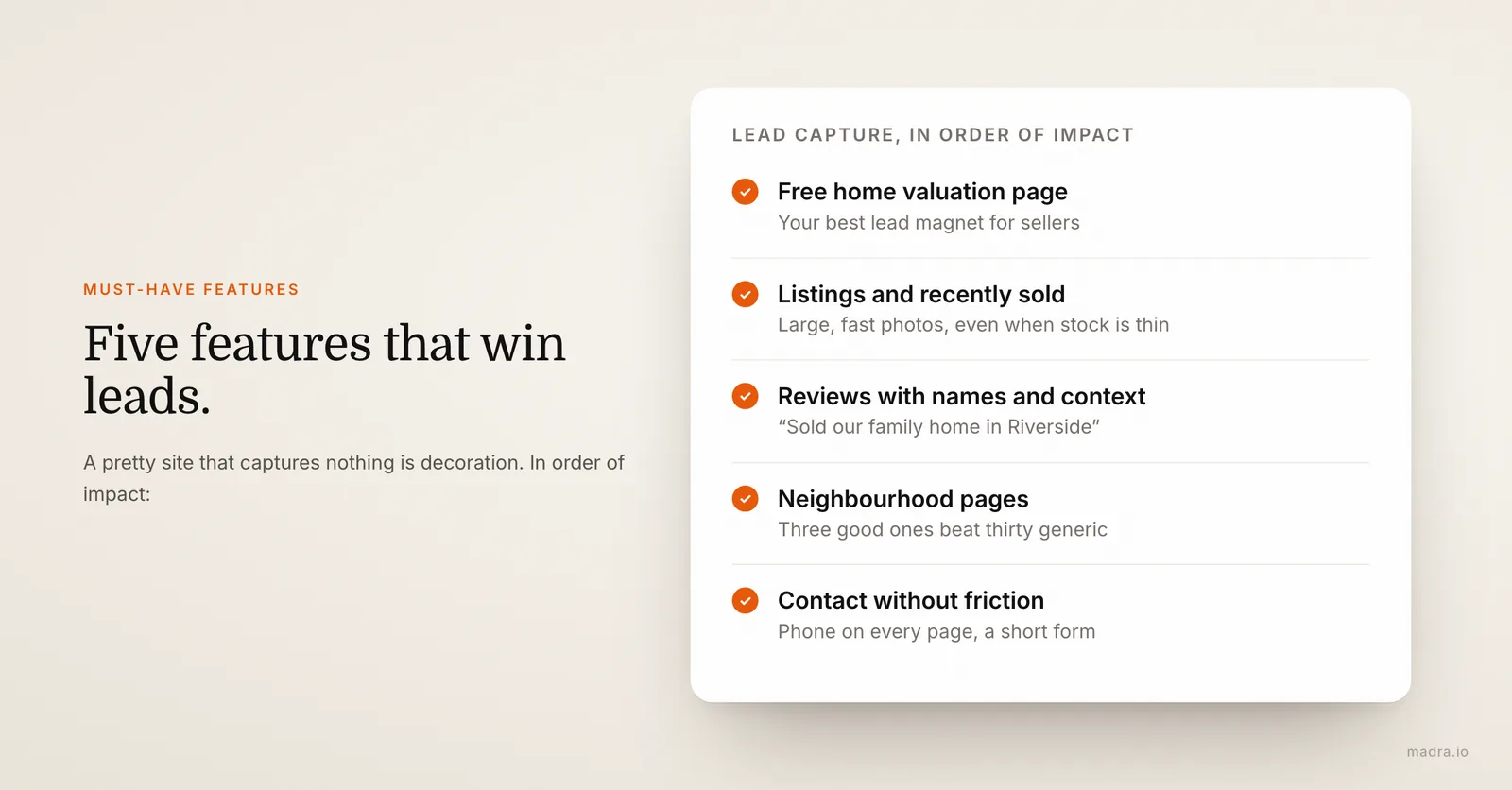
1. A free home valuation page: your best lead magnet
The single highest-value feature on a realtor's website is a page offering a free home valuation. It works because of timing: the moment a homeowner starts wondering "what is my house worth?" is the moment they enter the selling funnel. Offer them an answer in exchange for their address and contact details, and you have a seller lead months before any competitor knows they exist. Follow up with a personal, well-prepared estimate and you are the first agent in the room.
2. Listings and sold properties, presented properly
Show your current listings with large, fast-loading photos, and keep a "recently sold" section even when inventory is thin. Sold properties are proof of performance; an empty listings page with nothing else reads as an empty pipeline. If you have few active mandates, lead with sold results and neighborhood expertise instead.
3. Reviews with names and context
Pull your best Google reviews onto the site, with first names and the type of transaction ("Sold our family home in Riverside, March 2026"). Specificity is what makes social proof believable. Link out to your full Google profile so skeptics can verify.
4. Neighborhood pages that work for SEO
A page per area you serve ("Selling your home in [neighborhood]") does double duty: it convinces sellers you know their patch, and it is how Google decides to show you when someone searches "real estate agent in [neighborhood]". Three well-written area pages beat thirty generic ones.
5. Contact without friction
Phone number visible on every page, a short contact form (name, phone, message, nothing more), and ideally a way to book a call or valuation appointment directly. Every extra field and every hidden phone number costs you a percentage of your leads.
Want all of this without building any of it?
Describe your practice and your area, get a complete professional site with valuation lead capture within 24 hours. From $29.90/month, everything included.
The 5 mistakes that quietly kill realtor websites
Most agent websites do not fail loudly. They fail silently, by leaking the trust and the leads they were supposed to capture. These are the patterns we see most often.
- 1. The brochure site with no capture. A homepage, an about page, a contact form, and no reason for a visitor to leave their details. No valuation offer, no market report, no booking link. Traffic arrives, looks, and evaporates. If your site has no lead magnet, it is a business card, not a business tool.
- 2. Outdated listings and stale content. A "current listings" page showing properties sold eight months ago tells every visitor that you do not maintain your own shop window. Sellers draw the obvious conclusion about how their listing would be treated. An outdated site is worse than a modest one.
- 3. Ignoring mobile. The majority of real estate browsing happens on phones, often in the evening on a couch. Galleries that will not swipe, text that needs zooming, forms that fight autocomplete: each one is a lead walking out. Test your site on your own phone; if anything annoys you, it is losing you clients.
- 4. Trying to out-portal the portals. Some agents spend thousands on map search, saved-search accounts and filtering engines, competing with platforms that spend millions on exactly that. Visitors will always search inventory on the big portals. Your site's job is different: convert the people who are evaluating you. Spend on proof and capture, not on a worse version of a portal.
- 5. Skipping local SEO basics. No area names in page titles, no Google Business Profile linked, no consistent name-address-phone. The result: invisible for "real estate agent + your town", the only search that matters. Basic local SEO is not advanced marketing; it is the plumbing.
Real estate website cost: every method compared
So what does a real estate agent website actually cost in 2026? It depends entirely on the method, and the sticker price is rarely the full price. Here is the honest comparison for an agent or small agency site of 5 to 10 pages.
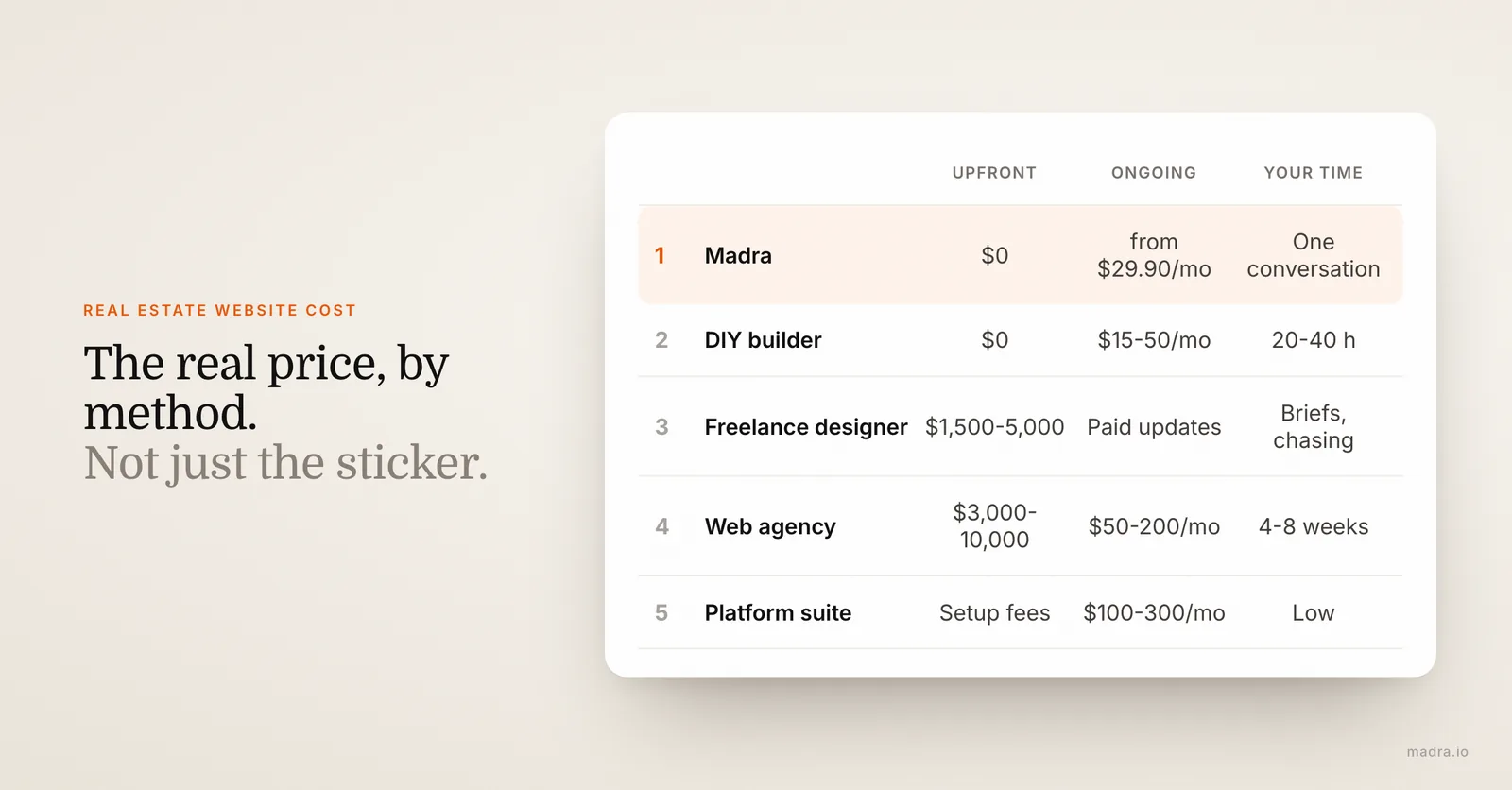
| Method | Upfront cost | Ongoing cost | Your time | Watch out for |
|---|---|---|---|---|
| DIY builder (Wix, Squarespace...) | $0 | $15-50/month | 20 - 40 hours, then upkeep forever | Amateur look next to competitors, SEO left to you, evenings lost to tweaking |
| Freelance designer | $1,500-5,000 | Hosting + paid updates ($50-100 per request) | Briefs, reviews, chasing | Availability after delivery; the site freezes when the freelancer moves on |
| Web agency | $3,000-10,000 | Maintenance retainer $50-200/month + billed changes | 4 - 8 weeks of project management | Change orders; real 3-year cost is 2 to 3 times the quote |
| Real estate platform suites | Setup fees vary | $100-300/month | Low | Template look shared with thousands of agents, long contracts, your data in their CRM |
| Managed subscription (Madra) | $0 | From $29.90/month, all inclusive | One conversation | Built for presence + lead capture, not for custom portal-style software |
Two traps hide in these numbers. First, the DIY option is only free if your time is worthless; forty hours of an agent's time is several viewings, valuations and follow-ups that never happened. Second, the agency quote is a down payment, not a total: hosting, maintenance and every post-delivery change get billed on top, which typically doubles the figure over three years.
The specialized real estate suites deserve a fair word: they bundle CRM and portal syndication, and for large teams that can be worth $200 a month. For an individual agent or a small agency, you mostly pay for heavy features you will not use, wrapped in a template your competitors also have.
How Madra ships your site in 24 hours
Madra sits in the managed subscription row of that table, and here is exactly how it works for a real estate professional.

AI builds it, a human expert verifies it
You describe your practice in a short conversation: your area, your specialty (family homes, apartments, luxury, rentals), your proudest sales, how clients should reach you. The AI generates a complete site: structure, professional copy in your tone, design, images. Then a human expert reviews every site before it goes live: design coherence, mobile rendering, SEO configuration, proofread text. You get the polish sellers expect from a top producer, without the agency process. (Curious how Madra stacks up against the alternatives? We compared every major player in our ranking of the best AI website builders.)
Live in 24 hours, not in two months
Your complete site is delivered within 24 hours of your brief. That is not a teaser or a wireframe; it is the finished site, ready for your review. Compare that with the 4-to-8-week agency timeline (we compared every method's real delays in how long it takes to build a website). In a market where mandates are won week by week, two months offline is measurable money.
Everything included, from $29.90/month
Plans start at $29.90/month (Essential), with Growth at $49.90/month ($39.90/month billed annually) and Acceleration at $79.90/month. Every plan includes creation, hosting, domain name, SSL, SEO setup and content changes. That last part matters more in real estate than anywhere else: new listing, price change, fresh sold property, new review. Send the update, it gets done, no invoice. Your site stays as current as your business, which is precisely what mistake number 2 above punishes agents for failing to do.
Frequently asked questions
How much does a real estate agent website cost?
A DIY builder costs 15 to $50 per month plus your time. A freelance designer charges 1,500 to $5,000 upfront, an agency 3,000 to $10,000, and both add maintenance fees afterwards. A managed subscription like Madra starts at $29.90 per month with creation, hosting, domain, SSL, SEO setup and content changes included.
Do realtors really need their own website if they are on portals?
Yes. Portals rent you visibility next to every competitor and own the lead. Your own website is where sellers vet you before a listing appointment, where your reviews and sold properties live, and where you capture leads that belong to you, such as home valuation requests.
What pages should a real estate website include?
At minimum: a homepage focused on your area and specialty, a listings or recent sales page, an about page with your photo and credentials, client reviews, a free home valuation page to capture seller leads, and a contact page with phone, email and service area clearly displayed.
What is a home valuation lead magnet?
It is a page offering homeowners a free estimate of their property's value in exchange for their address and contact details. It works because it targets sellers at the exact moment they start thinking about selling, which makes it the highest-value lead capture tool a real estate website can have.
How long does it take to build a real estate agent website?
An agency typically takes 4 to 8 weeks. A DIY builder takes 20 to 40 hours of your own time spread over weeks. With Madra, you describe your business in a short conversation and receive a complete professional site within 24 hours, reviewed by a human expert before going live.
Key takeaways
A real estate agent's website has one job: make you the obvious choice in your area before the first phone call. Everything else is detail.
- Portals rent you visibility; your site builds your brand. Sellers Google you before granting a mandate, and what they find decides the meeting.
- Lead with local proof: sold properties, neighborhood pages, dated reviews, your face. Then capture with a free home valuation page, the best lead magnet in the business.
- Avoid the silent killers: no capture, stale listings, broken mobile, competing with portals, and skipped local SEO.
- Count the real cost. Agencies run 3,000 to $10,000 plus fees, DIY costs your evenings, and a managed subscription delivers the whole package from $29.90 a month.
The agents winning listings online are rarely the ones who spent the most. They are the ones whose site is current, local and easy to contact. That can be live for you by this time tomorrow.
Your next mandate starts with your website.
Describe your practice, get a professional real estate site within 24 hours. Everything included from $29.90/month.
Create my site now