Website subscription vs web agency: where your money actually goes

You asked three agencies for a quote. The cheapest came back at $3,800, the most expensive at $9,500, and none of them could start before September. Meanwhile, an ad keeps following you around promising a professional website for less than the price of a phone plan. Which one is telling the truth?
Both, actually. The web agency and the website subscription are two different business models, built for two different kinds of projects. The problem is that agencies quote everyone the same way, whether you need a custom platform or a clean 6-page site for your plumbing business.
This guide puts real numbers on both sides: what agencies actually bill (including the fees they mention only after you sign), how design as a service works, and the honest answer to when each model wins. You are comparing offers right now, so let us make that comparison easy.
What a web agency really charges in 2026
An agency quote is only the first line of your total bill. To compare fairly against a monthly fee, you need the whole picture: the quote, the extras during the project, and everything that comes after delivery.
The initial quote: 3,000 to $15,000
For a standard business website of 5 to 10 pages, European agencies quote between 3,000 and $10,000 in 2026. Add e-commerce, custom features or a large content volume, and $15,000 is quickly on the table. Freelance web designers undercut that a little, typically 1,500 to $5,000, with more variance in quality and availability.
That quote covers a defined scope: an agreed number of pages, an agreed number of design revisions (usually two or three), and a delivery date that is best treated as an estimate. It does not cover what happens next.
Change orders: the fees nobody puts on the homepage
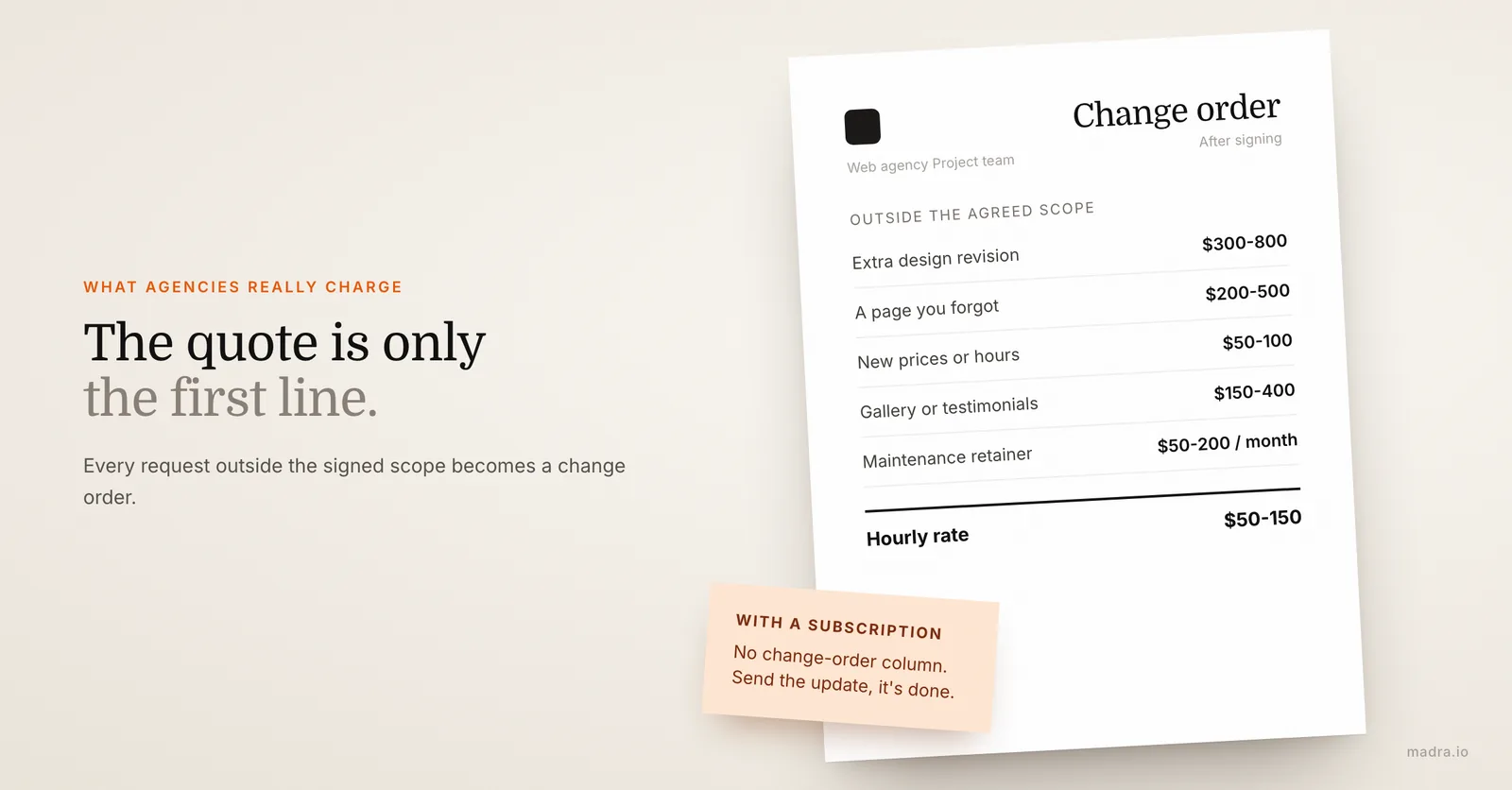
Every request outside the signed scope becomes a change order, billed at the agency's hourly rate of 50 to $150. In practice, that looks like this:
- One extra design revision after your included rounds are used: 300 to $800
- A page you forgot to specify (a team page, a second service): 200 to $500
- Updating your prices or opening hours after delivery: 50 to $100 per request
- A new photo gallery or testimonials block: 150 to $400
None of this is dishonest. The agency scoped a project, and you changed the project. But it means the real cost of an agency site is structurally higher than the quote, because no business gets its website exactly right on the first try.
The maintenance retainer: 50 to $200 per month, forever
Once the site is live, someone has to keep it that way. Agencies sell this as a maintenance retainer: 50 to $200 per month for backups, security updates and small fixes. Read the contract carefully, because most retainers cover keeping the site running, not keeping it current. Content changes, new pages and design refreshes usually remain billable on top.
Skip the retainer and you carry the risk yourself: an unpatched plugin, a hacked contact form, a site that silently goes down during your busiest week. Most agency clients end up paying it, which means the "one-time" project quietly becomes a monthly fee anyway. For the full breakdown of every pricing model on the market, see our guide to how much a website really costs.
An agency website is never a one-time purchase. It is a large upfront payment followed by a monthly retainer and per-request billing. Once you see it that way, comparing it to a subscription becomes a straightforward math problem.
Design as a service: the subscription alternative
The subscription model flips the structure. Instead of buying a project, you subscribe to an outcome: a professional website that exists, stays online, stays secure and stays up to date, for one fixed monthly fee.
A serious provider includes creation, hosting, domain name, SSL certificate, technical maintenance, SEO setup and content updates in that fee. There is no quote, no scope negotiation and no change orders: updating your prices is part of the service, not a billable event. We covered the mechanics of the model in depth in our guide to how a subscription website works, so here is the short version of why it changes the economics:
- Zero upfront capital. You start at $29.90 to $79.90 per month instead of writing a 5,000 euro check before seeing anything.
- The incentive flips. An agency earns most of its money before your site proves anything. A subscription provider has to keep earning your payment every month, or you leave.
- Updates stop being negotiations. You send a message, the change happens. Your site stays current instead of freezing at its delivery-day state.
- One bill covers everything. Hosting, domain, SSL and maintenance are not separate line items that creep up over time.
The honest caveat: subscription providers achieve these prices through standardization. They build business websites extremely well because they build them constantly, with efficient tooling. They do not build custom web applications, and the good ones will tell you so.
Agency vs subscription: the 3-year comparison
One year is too short to compare fairly, because the agency's cost is front-loaded. Three years is the honest window: long enough to include the agency's recurring fees, short enough to be realistic about how long a site design lasts. Here is the math for a standard business website.
| Cost item | Classic web agency | Website subscription |
|---|---|---|
| Creation | $3,000-10,000 upfront | $0 (included) |
| Hosting + domain + SSL | $80-400/year | Included |
| Maintenance retainer | $600-2,400/year | Included |
| Content updates | $50-150 per request | Included |
| Extra pages / evolutions | $200-500 each | Included |
| Time to launch | 4 to 8 weeks (often more) | 24 hours to 7 days |
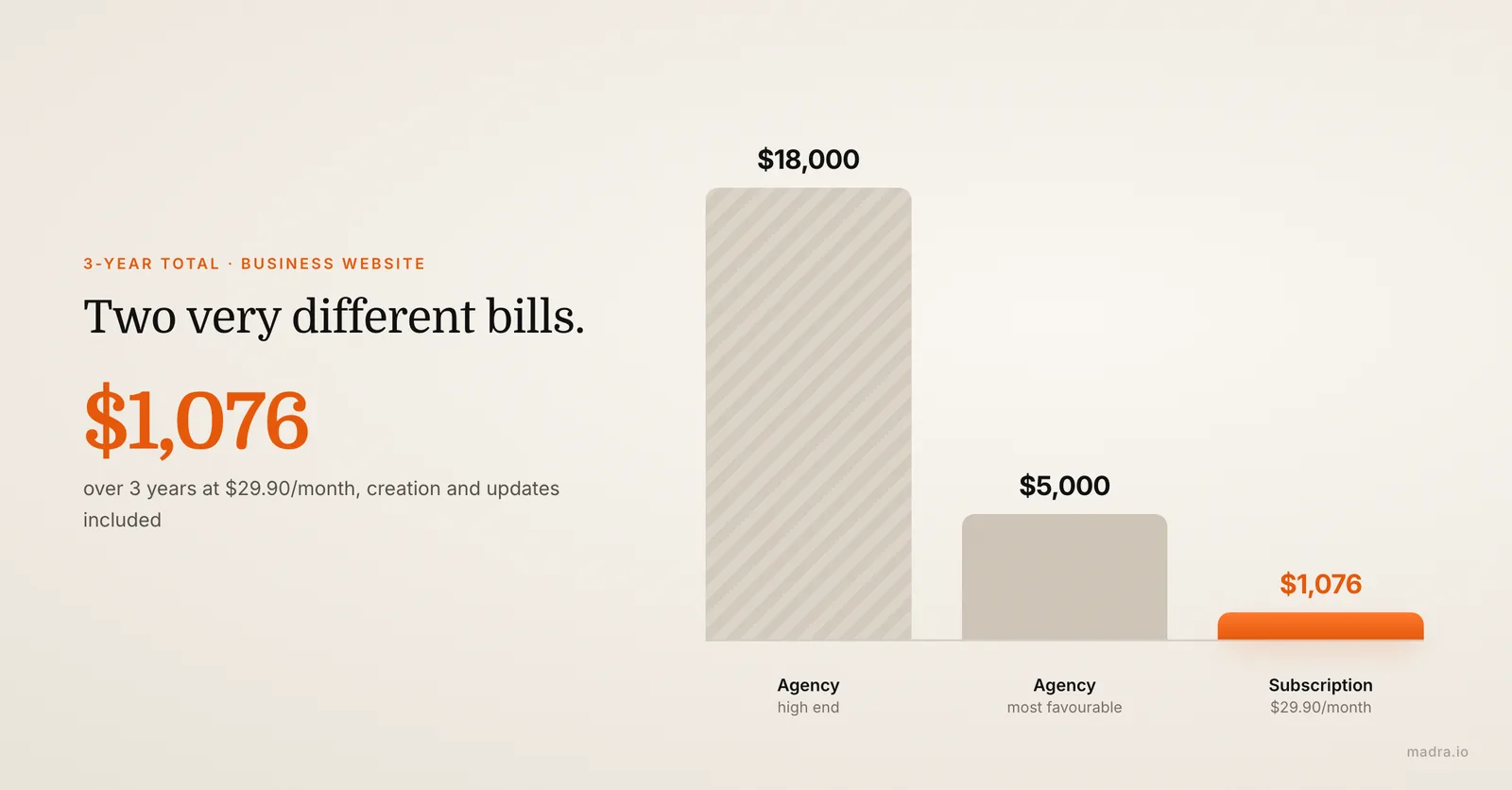
| 3-year total | $5,000-18,000 | $1,076 - $2,876 |
Even the most favorable agency scenario (a 3,000 euro build, minimal retainer, almost no changes) lands around $5,000 over 3 years. A subscription at $29.90 per month totals $1,076 over the same period. At $79.90 per month for a heavier plan, it is still $2,876, roughly half the agency's floor.
The gap is not because agencies overcharge. It is because you are paying for two different things: an agency sells you custom human labor, project management and meetings. A subscription sells you a productized service where the repetitive work is industrialized. For a standard business site, most of that custom labor buys you nothing visible.
Want to see the subscription side in practice?
Describe your business, get a complete professional site within 24 hours. Hosting, domain and content changes included from $29.90/month.
When a classic agency is still the right call
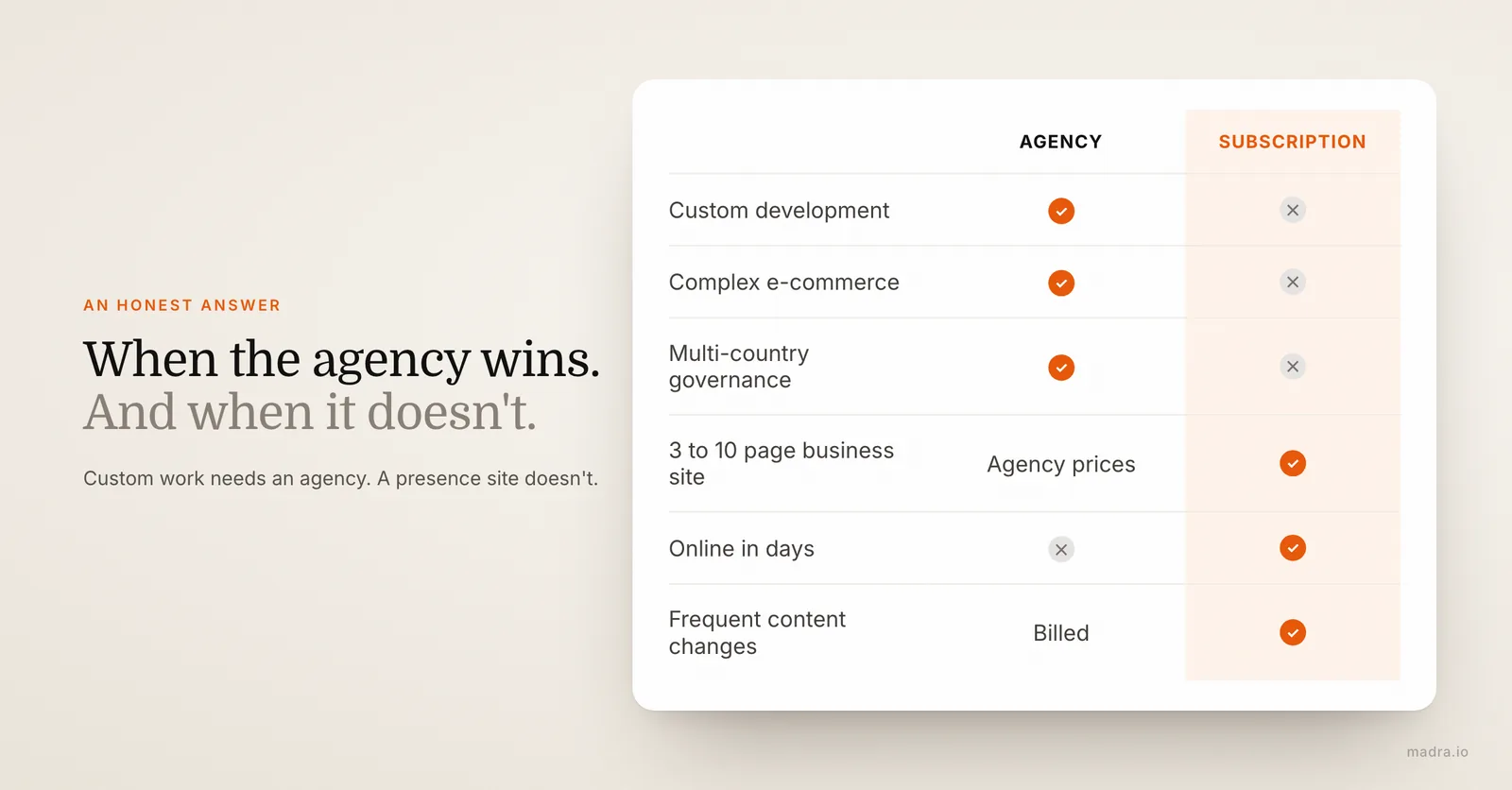
Now the part subscription providers rarely write: sometimes the agency is the correct answer, and pretending otherwise would be selling you the wrong tool. Choose a classic agency when your project has at least one of these traits.
You need custom development
A booking engine with complex pricing rules, a client portal, a marketplace, a configurator, an integration with your internal ERP: this is software development, not website creation. Subscriptions do not cover it, and a good agency with developers on staff is worth every euro here.
Your e-commerce is genuinely complex
A catalog of thousands of products, multi-warehouse logistics, B2B pricing tiers, synchronization with a POS system: that project needs a scoping phase, an architect and a real budget. A simple online store fits the subscription world; a retail operation does not.
You are a large organization with governance needs
Multi-country sites, legal review workflows, strict brand guidelines enforced across departments, accessibility compliance audits: agencies are structured for stakeholders, committees and documentation. That overhead is exactly what you are paying for, and at that scale it is justified.
Brand strategy is the actual deliverable
If what you really need is a repositioning, a naming exercise, a full visual identity and a launch campaign, with the website as one artifact among several, hire an agency. The website is the cheap part of that engagement.
If none of these describe you (and for most freelancers, tradespeople, practices and local businesses, none do), then you would be paying agency prices for subscription work.
When a subscription is the smarter choice
The subscription model wins whenever the job is a professional presence site done well. Concretely, it is the better call when:
- Your site is 3 to 10 pages presenting your services, your proof and a way to contact you. This describes the vast majority of business websites.
- Cash flow matters more than ownership of a project. $30 a month is an operating expense; $6,000 upfront is an investment decision that delays everything else.
- You need to be online fast. A subscription site goes live in days. An agency slot in September does not answer the prospects searching for you in July.
- Your content changes regularly. Prices, menus, hours, team, seasonal offers: if updates are frequent, per-request agency billing punishes exactly the behavior that keeps a site alive.
- You have no technical person in-house. With a subscription, hosting, security and backups are structurally someone else's job, not a retainer you have to remember to buy.
One warning applies to both models: check who owns what. Whether it is an agency or a subscription, your content and your domain name must remain yours, in writing, before you sign anything.
Where Madra fits: AI plus a human expert
Madra is a website subscription, so you know which side of this comparison we sit on. Here is specifically how we run the model.

AI builds, a human verifies
You describe your business in a short conversation. The AI generates a complete site: structure, copy, design, images. Then a human expert reviews every site before it goes live: design coherence, mobile rendering, SEO configuration, proofread copy. You get agency-grade quality control at subscription economics, because the human spends time on judgment instead of repetitive production. To see how Madra compares with the rest of the market, we ranked every major player in our guide to the best AI website builders.
Live in 24 hours
The site is delivered within 24 hours of your brief. Not a draft or a mockup: a complete site ready for your review. Compare that to the 4-to-8-week agency timeline, during which your competitors are the only answer Google has for your customers.
Everything included, from $29.90/month
Plans start at $29.90/month (Essential), with Growth at $49.90/month ($39.90/month billed annually) and Acceleration at $79.90/month. Every plan includes creation, hosting, domain name, SSL, SEO setup and content changes. There is no change-order column in our pricing because there are no change orders: send the update, it gets done.
And your content stays yours. If you leave, you can request a full export. A subscription should earn your next month, not hold it hostage.
Frequently asked questions
Is a website subscription cheaper than a web agency?
Over 3 years, almost always. An agency project costs 3,000 to $10,000 upfront, plus a maintenance retainer of 50 to $200 per month and billed change orders. A subscription at $29.90 per month totals about $1,076 over 3 years with creation, hosting, domain and updates included.
When is a classic web agency the better choice?
Choose an agency for complex custom projects: web applications, large e-commerce catalogs with specific logistics, multi-country corporate sites, or heavy third-party integrations. If your project needs custom development and a dedicated project manager, an agency is worth the price.
What is a change order and why do agencies bill them?
A change order is any request outside the original scope of the signed quote: a new page, a text edit after delivery, a design tweak. Agencies bill them at 50 to $150 per hour because their model is project-based. Subscriptions include changes because their model is service-based.
Do I lose quality by choosing a subscription over an agency?
Not for a standard business website. For a 5 to 10 page site, a good subscription service delivers the same result as an agency: custom design, mobile responsive, SEO configured. Quality drops only if you pick a provider that pastes your logo on a generic template, which happens on both sides of the fence.
Can I switch from my agency site to a subscription service?
Yes. You own your content (text, images, logo), so a subscription provider can rebuild your site from it. Check who owns your domain name first: if the agency registered it in their name, ask for a transfer before cancelling anything.
What does a web design agency monthly fee usually cover?
An agency maintenance retainer of 50 to $200 per month usually covers backups, plugin updates and small fixes. It rarely includes content changes, new pages or design updates, which are billed separately. A website subscription covers all of it, creation included.
Key takeaways
The agency vs subscription question is not about which model is better. It is about which model matches your project.
- Count the whole agency bill, not the quote: add change orders, the maintenance retainer, hosting and the weeks of waiting. Over 3 years, a standard site costs 5,000 to $18,000 through an agency versus $1,100 to $2,900 on subscription.
- Pick an agency for custom work: web apps, complex e-commerce, multi-country governance, brand strategy engagements. That is what agency overhead is for.
- Pick a subscription for a business presence site: faster, radically cheaper, and structurally incentivized to keep serving you after launch.
If your project is a professional site that presents your business and brings in clients, the math has a clear answer. The only remaining question is how soon you want to be online.
Skip the quotes. Get the site.
Describe your business, get a professional website within 24 hours. Everything included from $29.90/month.
Create my site now